

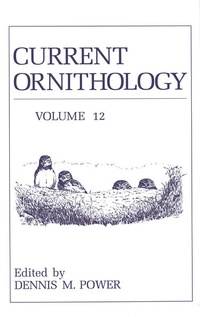
Current Ornithology
Published on 21. October 2012
Book
Paperback/Softback
XIII, 278 pages
978-1-4613-5743-8 (ISBN)
Description
In
Volume 12
, eminent international ornithologists further elucidate endocrinological correlates of mating strategies and hormones and reproductive behavior; assess the value of the ''brood reduction hypothesis'' in explaining ''the paradox of hatching asynchrony''; and explore the validity and sensitivity of growth bands in feathers as an indication of nutritional condition and the use of feather banding in studying growth. Chapters are well supported with charts, maps, schematic diagrams, and photographs.
Current Ornithology
is the only English-language publication currently devoted exclusively to extensive reviews and synthesis of topics pertaining to all aspects of the biology of birds. Chapters fall under such diverse rubrics as ecology, evolution, behavior, phylogeny, behavioral ecology, anatomy and physiology, and conservation biology. All authors are leading authorities on their subjects, and each chapter is refereed by experts in the topics covered. Although all chapters focus primarily on birds, some topics, such as the social cognition of birds as compared to primates (Volume 13), have significant application to disciplines outside of ornithology.
Current Ornithology
aims to provide an accessible, up-to-date, accurate source of data and to contribute to conceptual generalization and unification across the biological sciences.
Reviews / Votes
` As has been true in all previous volumes, the editing and writing of these chapters is excellent and the content remarkably good, particularly given the length of the series....As usual, these sources are a gold mine for researchers, graduate students, and teachers. 'The Wilson Bulletin
` For researchers interested in plumage evolution, hatching asynchrony or any of the other topics reviewed, [Volume 12] will be obligatory reading. For others interested in learning about new fields, this is one of the best places to start. '
Recent Ornithological Publications
` I do suggest that university libraries buy this useful series. '
Animal Behavior
More details
Series
Edition
Softcover reprint of the original 1st ed. 1995
Language
English
Place of publication
New York
United States
Target group
Professional and scholarly
Research
Illustrations
XIII, 278 p.
Dimensions
Height: 229 mm
Width: 152 mm
Thickness: 17 mm
Weight
438 gr
ISBN-13
978-1-4613-5743-8 (9781461357438)
DOI
10.1007/978-1-4615-1835-8
Schweitzer Classification
Other editions
Additional editions
D.M. Power
Current Ornithology
Book
07/1995
1st Edition
Kluwer Academic / Plenum Publishers
€96.00
Article exhausted; check different version
Content
1 Testosterone and Polygyny in Birds.- 1. Introduction.- 2. Types of Polygyny and Associated Testosterone Profiles.- 3. Testosterone Levels and Breeding Ecology, Age, and Reproductive Success.- 4. Testosterone, Male-Male Aggression, and Parental Care.- 5. Testosterone Levels and Social Interactions.- 6. Costs of High Testosterone Levels.- 7. Conclusions.- 8. Summary.- References.- 2 Using Migration Counts to Monitor Landbird Populations: Review and Evaluation of Current Status.- 1. Introduction.- 2. What is a "Migration Count"?.- 3. Collection of Migration Count Data.- 4. Analysis of Migration Count Data.- 5. Evaluation of Migration Counts for Population Monitoring.- 6. Synthesis: The Pros and Cons of Using Migration Counts for Population Monitoring.- 7. The Future of Migration Monitoring in North America.- References.- 3 Ptilochronology: A Review and Prospectus.- 1. Introduction.- 2. Causes of Growth Bars.- 3. Ubiquity of Growth Bars.- 4. One Growth Bar Denotes 24 Hours of Feather Growth.- 5. Growth Bar Width is Sensitive to Nutritional Condition.- 6. Other Possible Factors Controlling Growth Bar Width.- 7. Applications.- 8. Prospectus.- References.- 4 Individual Voice Discrimination in Birds.- 1. Introduction.- 2. Neighbor-Stranger Recognition and Evidence for Individual Recognition by Song.- 3. Processes of Individual Recognition.- 4. How to Distinguish among Processes of Individual Recognition.- 5. Design and Execution of Experiments Testing Individual "Voice" Recognition in the Field.- 6. The Potential Significance of Individual "Voice" Recognition.- 7. Signature Adaptations and Perceptual Adaptations for Individual Recognition.- 8. Concluding Remarks.- 9. Summary.- References.- 5 The Evolution Of Bird Coloration And Plumage Elaboration: A Review ofHypotheses.- 1. Introduction.- 2. The Hypotheses.- 3. Future Directions for the Study of Animal Coloration.- 4. Conclusions.- References.- 6 Hatching Asynchrony And The Onset Of Incubation In Birds, Revisited: When Is The Critical Period?.- 1. Introduction.- 2. The Onset of Incubation as the Principal Proximate Cause of Hatching Patterns.- 3. Hatching Patterns in Birds.- 4. Hypotheses for the Evolution of Hatching Asynchrony.- 5. Findings from Experimental Tests.- 6. Synthesis: Integrating Multiple Hypotheses through Modeling.- 7. Conclusions.- 8. Summary.- References.