

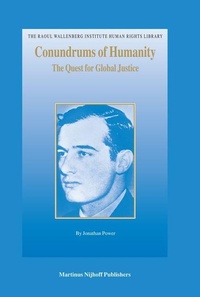
Conundrums of Humanity
The Quest for Global Justice
Published on 24. April 2007
Book
Hardback
256 pages
978-90-04-15513-8 (ISBN)
Description
Sixty years since the end of World War II is two generations. And two generations is long enough to measure whether there has been a substantial change in direction in how mankind orders its affairs. It is clear that it has. Not just in matters of war and peace- there has not been a Third World War- but in its attitude to poverty, economic progress, human rights, its habitat and its relationship to the other sex and its offspring. In all there have been great strides forward that at the time of the ending of the war seemed barely conceivable.
Conundrums of Humanity poses eleven questions for our future progress, ranging from "Can we diminish War?" to "How far and fast can we push forward the frontiers of Human Rights?" to "Will China dominate the century?". The answers to these questions, the author believes, growing out of his long experience as a foreign correspondent and columnist for the International Herald Tribune, are largely positive ones, despite the hurdles yet to be overcome. They all depend for fruition, partly on building on the important work already accomplished, partly on creating a more benign and positive atmosphere in the world order and partly on demonstrating how the world can be even better in the future and thus giving the world's peoples a sense of forward momentum.
Conundrums of Humanity poses eleven questions for our future progress, ranging from "Can we diminish War?" to "How far and fast can we push forward the frontiers of Human Rights?" to "Will China dominate the century?". The answers to these questions, the author believes, growing out of his long experience as a foreign correspondent and columnist for the International Herald Tribune, are largely positive ones, despite the hurdles yet to be overcome. They all depend for fruition, partly on building on the important work already accomplished, partly on creating a more benign and positive atmosphere in the world order and partly on demonstrating how the world can be even better in the future and thus giving the world's peoples a sense of forward momentum.
Reviews / Votes
'His is a powerful and comprehensive statement of ways to make the world better. He is unreasonably good, as demonstrated by his personal commitment to the developing world, the fortunes of the poor, the defense of human rights, and his devotion to the society's progress. Is that worth the Nobel Prize? I say, why not?'William Pfaff, Prospect, 2007 , 137 .
"An account, in epic sweep, of humanity and its messy, uncertain trajectory....It is an ambitious and complex book....His text combines scientific attention to detail with impressionistic sensitivity to the wealth and nuances of human experience....The text is, in scholastic terms, rare. It brings together analytical rigour and human breadth of experience....an easy but exacting style....Power is justified in undertaking this ambitious task through his bringing to bear a unique integrity."
Stephen Riley, Human Rights Law Review
More details
Series
Language
English
Place of publication
Netherlands
Publishing group
Brill
Target group
College/higher education
Product notice
sewn/stitched
Cloth over boards
Dimensions
Height: 244 mm
Width: 165 mm
Thickness: 18 mm
Weight
544 gr
ISBN-13
978-90-04-15513-8 (9789004155138)
Copyright in bibliographic data and cover images is held by Nielsen Book Services Limited or by the publishers or by their respective licensors: all rights reserved.
Schweitzer Classification
Other editions
Additional editions

Software
03/2007
Brill | Nijhoff
Unfortunately, price unknown
Available (delivery time upon request)
Person
Jonathan Power did his bachelor's degree at Manchester University and master's at the University of Wisconsin, Madison. After university, he worked in Tanzania as a volunteer in the ministry of agriculture and later worked on the staff of Martin Luther King during the Chicago civil rights campaign. He has been a foreign affairs commentator for The International Herald Tribune for over twenty years. He has also contributed regular columns to the New York Times, the Washington Post, the Los Angeles Times, the Boston Globe and the Times of London. He wrote for Encounter and now is a contributing editor and regular writer for Prospect magazine. In 1972 he won the Silver Medal at the Venice film festival for the documentary, It's Ours Whatever They Say. He has published six previous books and is working on his first novel. His interviews with world leaders have been widely published and he is an itinerant traveller and lecturer. He is an associate of the TFF, The Transnational Foundation for Peace and Future Research.
Content
Foreword; Acknowledgements; Introduction: Rights for All?; 1. Can We Avoid a Clash of Civilizations?; 2. Can We Allow the Free Movement of People?; 3. Can We Diminish War?;
4. Can We Get Rid of Nuclear Weapons?; 5. How Far and Fast Can We Push the Frontier of Human Rights Observance?; 6. Can Human Rights Be Pursued by Making War?; 7. Does the United Nations Have What it Takes?; 8. Can We Feed All the People?; 9. How Far Can Human Development Progress?; 10. Does Africa Have a Future?; 11. Will China Dominate the Century?; Index.
4. Can We Get Rid of Nuclear Weapons?; 5. How Far and Fast Can We Push the Frontier of Human Rights Observance?; 6. Can Human Rights Be Pursued by Making War?; 7. Does the United Nations Have What it Takes?; 8. Can We Feed All the People?; 9. How Far Can Human Development Progress?; 10. Does Africa Have a Future?; 11. Will China Dominate the Century?; Index.