

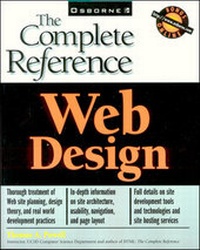
Web Design: The Complete Reference
Published on 16. June 2000
Book
Paperback/Softback
756 pages
978-0-07-212297-8 (ISBN)
Description
Get complete coverage of Web site design, including theories, techniques, and the latest technologies. Learn to design, build, and maintain a site and handle e-commerce and security. The author, Thomas Powell, developed the Web Design Certificate Program at the University of California, San Diego.
More details
Series
Language
English
Place of publication
United States
Publishing group
McGraw-Hill Education - Europe
Target group
Professional and scholarly
Illustrations
325 illustrations
Dimensions
Height: 231 mm
Width: 188 mm
Thickness: 53 mm
Weight
1746 gr
ISBN-13
978-0-07-212297-8 (9780072122978)
Copyright in bibliographic data and cover images is held by Nielsen Book Services Limited or by the publishers or by their respective licensors: all rights reserved.
Schweitzer Classification
Other editions
New editions
Thomas Powell
Web Design Complete Reference
Book
08/2002
2nd Edition
McGraw-Hill Professional
€37.13
Article exhausted; check different version
Person
Thomas Powell is the founder and principal of Powell Internet Consulting, Inc. a San Diego-based web design firm that specializes in Web research and development and site construction for high-tech companies. He developed the Web Design Certificate Program at UCSD, teaches web publishing classes and serves as senior instructor and faculty advisor in the University's Information Technology Program. He holds a Bachelor of Science from UCLA and a Master's degree in Computer Science from UCSD. Powell is the author of three books: HTML: The Complete Reference and HTML Programmer's Reference for Osborne and Web Site Engineering: Beyond Web Page Design for Prentice Hall.
Content
Part I: Core Web Design Issues. Chapter 1: What Is Web Design? Chapter 2: The Web Design Process. Chapter 3: Designing for Users. Part II: Site Organization and Navigation. Chapter 4: Site Types and Architectures. Chapter 5: Navigation Theory and Practice. Chapter 6: Linking: Text, Buttons, Icons, and Graphics. Chapter 7: Search and Design. Chapter 8: Site Maps, Indexes,and Other Navigational and Use Aids. Chapter 9: Page Types and Layouts. Chapter 10: Text. Chapter 11: Colors, Images, and Backgrounds. Chapter 12: Building Interactivity Using GUI Features. Part IV: Technology and Web Design. Chapter 13: Web Technologies and Their Effect on Web Design. Chapter 14: Site Delivery and Management. Part V: Future Directions. Chapter 15: The Future of Web Design. Part VI: Appendixes. Appendices. Index. Chapter 4: Usability. Chapter 5: GUI Design and the Web. Section III: Site Organization and Navigation. Chapter 6: Site Types, Architectures and Styles. Chapter 7: Navigation. Chapter 8: Links, Buttons, Icons, and Imagemaps. Chapter 9: Searching. Chapter 10: Site Maps, Indexes, and Other Navigational Aids. Section IV: Page Design. Chapter 11: Page Types and Layout. Chapter 12: Text. Chapter 13: Colors, Images and Backgrounds. Chapter 14: Web GUI Widgets. Chapter 15: Core Web Technologies and Their Effect on Web Design. Chapter 16: The Use of Multimedia in Web Design. Chapter 17: Programming and Web Design. Chapter 18: Site Delivery and Management. Chapter 19: Site Evaluation Procedures. Section V: Future Directions. Chapter 20: The Future of Web Design. Appendices: A: Core Web Site Design Principles. B: Web Site Evaluation Checklist. C: Web Font Reference. D: Color Reference. E: GUI Widget Reference.