

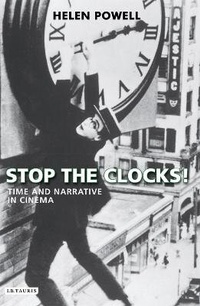
Stop the Clocks!
Time and Narrative in Cinema
Published on 18. March 2012
Book
Hardback
192 pages
978-1-78076-216-6 (ISBN)
Description
The clock plays a significant part in our overall understanding of temporality. But while it functions to simplify, regulate and coordinate, it fails to reflect and communicate the more experiential dimensions of time. Each living moment is always more than clock time: it comprises a multiplicity of temporal frames, a fusion of past, present and future projections, dreams and memories. Due to the contemporary pace of life we rarely think about such complexities but, as Helen Powell demonstrates in this book, cinema has been addressing this issue since its inception.
Stop the Clocks! examines filmmakers' relationship to time and its visual manipulation and representation from the birth of the medium to the digital present, focusing not only on experimentation in narrative construction but also engaging with films that take time as their subject matter, such as A Matter of Life and Death, Donnie Darko, Interview with a Vampire, Lost Highway and Pulp Fiction. Helen Powell asks what underpins the enduring appeal of the science fiction genre with filmmakers and audience and how cinematography might inform our conceptualisation of other imagined temporal worlds, including the afterlife. She examines the role of angels and vampires in contemporary cinema, as well as the distinctive time schemes of new media and their implications for rethinking time and the moving image through digitisation.
Broad-based and accessible, Stop the Clocks! will appeal to a wide interdisciplinary audience and provides a useful sourcebook on undergraduate and postgraduate courses in film and other arts and media-based disciplines.
Stop the Clocks! examines filmmakers' relationship to time and its visual manipulation and representation from the birth of the medium to the digital present, focusing not only on experimentation in narrative construction but also engaging with films that take time as their subject matter, such as A Matter of Life and Death, Donnie Darko, Interview with a Vampire, Lost Highway and Pulp Fiction. Helen Powell asks what underpins the enduring appeal of the science fiction genre with filmmakers and audience and how cinematography might inform our conceptualisation of other imagined temporal worlds, including the afterlife. She examines the role of angels and vampires in contemporary cinema, as well as the distinctive time schemes of new media and their implications for rethinking time and the moving image through digitisation.
Broad-based and accessible, Stop the Clocks! will appeal to a wide interdisciplinary audience and provides a useful sourcebook on undergraduate and postgraduate courses in film and other arts and media-based disciplines.
More details
Language
English
Place of publication
United Kingdom
Publishing group
Bloomsbury Publishing PLC
Target group
College/higher education
Professional and scholarly
Illustrations
12 integrated bw
Dimensions
Height: 234 mm
Width: 156 mm
Weight
428 gr
ISBN-13
978-1-78076-216-6 (9781780762166)
Copyright in bibliographic data and cover images is held by Nielsen Book Services Limited or by the publishers or by their respective licensors: all rights reserved.
Schweitzer Classification
Other editions
Additional editions
E-Book
03/2012
1st Edition
I.B. Tauris
€27.49
Available for download
Person
Helen Powell is Senior Lecturer in the School of Arts and Digital Industries at the University of East London. She has also worked in the advertising industry and adopts an interdisciplinary approach in her teaching, writing, and research.
Content
Introduction: Cinema as Time Machine
Chapter 1: Real Time
Chapter 2: Future Time
Chapter 3: Dreaming Time
Chapter 4: Consuming Time
Chapter 5: Fractured Time
Conclusion: Time in the Digital Age
Bibliography
Index
Chapter 1: Real Time
Chapter 2: Future Time
Chapter 3: Dreaming Time
Chapter 4: Consuming Time
Chapter 5: Fractured Time
Conclusion: Time in the Digital Age
Bibliography
Index