

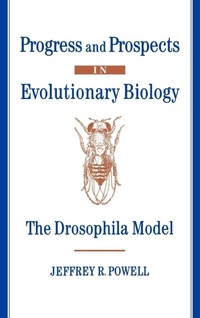
Progress and Prospects in Evolutionary Biology
The Drosophila Model
Published on 6. November 1997
Book
Hardback
576 pages
978-0-19-507691-2 (ISBN)
Description
The common fruitfly, Drosophila, is the most extensively studied of all organisms in genetical research. Thus, it would appear to be the best model for achieving new insights. Its use in evolutionary studies has resulted in an explosion of knowledge which has never before been gathered into a single volume. This book spans the full range of evolutionary studies - population genetics, ecology, ecological genetics, speciation, phylogenetics, genome evolution, molecular evolution, and development. In covering these topics, highlights of empirical research are emphasized and are put into the context of major issues in evolution.
Reviews / Votes
"The author provides a comprehensive review of the enormous evolutionary literature concerned with genus Drosophila. Although he laments the fact that only 1,750 out of the existing 60,000 papers on the subject are cited in his book, it is quite obvious that any attempt at more complete coverage would produce an unreadable book. As it is, the book is highly readable and very useful. It can be consulted for things as diverse as per locus mutation rates,patterns of DNA-DNA hybridization, breeding ecology, reproductive isolation, phylogenetics, and developmental biology of various Drosophila species. Presentation, although rigorous, is accessible to students
who have successfully grasped the material from an introductory course on evolution. An interesting upper-level undergraduate course could be based on this book, since applying very different aspects of evolutionary biology to the same genus seems to be a good pedagogical approach."--The Quarterly Review of Biology
"Drosophila is a model organism for research at many levels: molecular biology, genetics, genomics, development, and neurobiology. It is Powell's thesis that Drosophila is also the model organism of choice for evolutionary biology. . . . [T]he book reviews Drosophila population biology and ecology more thoroughly than these have been reviewed for nearly half a century. . . . [T]hose who wish to know where we are at present in
Drosophila evolutionary biology, and how we got here, should start by examining Powell's book. . . . Powell's chapters dealing with molecular population genetics and with genome evolution are excellent. . . . His choice of topics is
judicious and his level of presentation consistent. . . . [He] also does a commendable job in the chapters on speciation and phylogenetics. . . . [E]very laboratory working with any aspect of Drosophila evolutionary biology or ecology should have the Powell book near at hand."--Evolution
"The twelve chapters in this text serve as a reference that will be of use to researchers and students using the Drosophila melanogaster model in developmental biology, molecular biology, neurobiology, and evolutionary biology. The book also includes an index, a list of references, and many figures." -- Biosis, Vol 50, Issue 3, March 22, 1998
"The author provides a comprehensive review of the enormous evolutionary literature concerned with genus Drosophila. Although he laments the fact that only 1,750 out of the existing 60,000 papers on the subject are cited in his book, it is quite obvious that any attempt at more complete coverage would produce an unreadable book. As it is, the book is highly readable and very useful. It can be consulted for things as diverse as per locus mutation rates,
patterns of DNA-DNA hybridization, breeding ecology, reproductive isolation, phylogenetics, and developmental biology of various Drosophila species. Presentation, although rigorous, is accessible to students
who have successfully grasped the material from an introductory course on evolution. An interesting upper-level undergraduate course could be based on this book, since applying very different aspects of evolutionary biology to the same genus seems to be a good pedagogical approach."--The Quarterly Review of Biology
"Drosophila is a model organism for research at many levels: molecular biology, genetics, genomics, development, and neurobiology. It is Powell's thesis that Drosophila is also the model organism of choice for evolutionary biology. . . . [T]he book reviews Drosophila population biology and ecology more thoroughly than these have been reviewed for nearly half a century. . . . [T]hose who wish to know where we are at present in
Drosophila evolutionary biology, and how we got here, should start by examining Powell's book. . . . Powell's chapters dealing with molecular population genetics and with genome evolution are excellent. . . . His choice of topics is
judicious and his level of presentation consistent. . . . [He] also does a commendable job in the chapters on speciation and phylogenetics. . . . [E]very laboratory working with any aspect of Drosophila evolutionary biology or ecology should have the Powell book near at hand."--Evolution
"The twelve chapters in this text serve as a reference that will be of use to researchers and students using the Drosophila melanogaster model in developmental biology, molecular biology, neurobiology, and evolutionary biology. The book also includes an index, a list of references, and many figures." -- Biosis, Vol 50, Issue 3, March 22, 1998
More details
Language
English
Place of publication
New York
United States
Target group
Professional and scholarly
Illustrations
halftones, numerous line figures, tables
Dimensions
Height: 235 mm
Width: 157 mm
Thickness: 38 mm
Weight
1081 gr
ISBN-13
978-0-19-507691-2 (9780195076912)
Copyright in bibliographic data and cover images is held by Nielsen Book Services Limited or by the publishers or by their respective licensors: all rights reserved.
Schweitzer Classification
Other editions
Additional editions
E-Book
09/1997
1st Edition
OUP eBook
€88.49
Available for download
Person
Content
1. Introduction and Overview ; 2. Population Genetics - Genes ; 3. Population Genetics - Inversions ; 4. Population Genetics - Laboratory Studies ; 6. Ecological Genetics ; 7. Speciation ; 8. Phylogenetics ; 9. Genome Evolution ; 10. Molecular Evolution ; 11. Development and Evolution ; 12. Retrospective and Prospective