

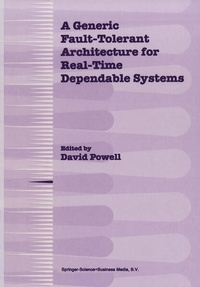
A Generic Fault-Tolerant Architecture for Real-Time Dependable Systems
Published on 31. January 2001
Book
Hardback
XVIII, 242 pages
978-0-7923-7295-0 (ISBN)
Description
The design of computer systems to be embedded in critical real-time applications is a complex task. Such systems must not only guarantee to meet hard real-time deadlines imposed by their physical environment, they must guarantee to do so dependably, despite both physical faults (in hardware) and design faults (in hardware or software). A fault-tolerance approach is mandatory for these guarantees to be commensurate with the safety and reliability requirements of many life- and mission-critical applications. This book explains the motivations and the results of a collaborative project', whose objective was to significantly decrease the lifecycle costs of such fault tolerant systems. The end-user companies participating in this project already deploy fault-tolerant systems in critical railway, space and nuclear-propulsion applications. However, these are proprietary systems whose architectures have been tailored to meet domain-specific requirements. This has led to very costly, inflexible, and often hardware-intensive solutions that, by the time they are developed, validated and certified for use in the field, can already be out-of-date in terms of their underlying hardware and software technology.
More details
Edition
2001 ed.
Language
English
Place of publication
New York
United States
Target group
Professional and scholarly
Research
Product notice
sewn/stitched
Cloth over boards
Illustrations
XVIII, 242 p.
Dimensions
Height: 234 mm
Width: 156 mm
Thickness: 16 mm
Weight
544 gr
ISBN-13
978-0-7923-7295-0 (9780792372950)
DOI
10.1007/978-1-4757-3353-2
Schweitzer Classification
Other editions
Additional editions
E-Book
04/2013
Springer
€149.79
Available for download
Book
12/2010
Springer
€160.49
Shipment within 15-20 days
Content
1 Introduction and Overview.- 2 Inter-Channel Communication Network.- 3 Scheduling.- 4 Error Processing and Fault Treatment.- 5 Output Consolidation.- 6 Multilevel Integrity Mechanisms.- 7 Architecture Development Environment.- 8 Formal Verification.- 9 Dependability Evaluation.- 10 Demonstrators.- Project Consortium.- Abbreviations.- References.