

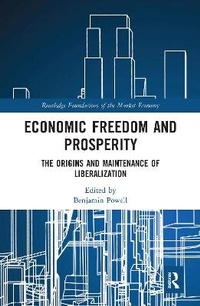
Economic Freedom and Prosperity
The Origins and Maintenance of Liberalization
1st Edition
Published on 30. June 2020
Book
Paperback/Softback
266 pages
978-0-367-58470-2 (ISBN)
Description
Economic theory and a growing body of empirical research support the idea that economic freedom is an important ingredient to long-run economic prosperity. However, the determinants of economic freedom are much less understood than the benefits that freedom provides. Economic Freedom and Prosperity addresses this major gap in our knowledge. If private property and economic freedom are essential for achieving and maintaining a high standard of living, it is crucial to understand how improvements in these areas have been achieved and whether there are lessons that can be replicated in less free areas of the world today.
In this edited collection, contributors investigate this research question through multiple methodologies. Beginning with three chapters that theoretically explore ways in which economic freedom might be better achieved, it then moves on to a series of empirical chapters that examine questions including the speed and permanence of reform, the deep long-run determinants of economic freedom, the relationship between voice and exit in impacting freedom, the role of crises in generating change, and immigration. Finally, the book considers the evolution of freedom in China, development economics, and international trade, and it concludes with a consideration of what is necessary to promote a humane liberalism consistent with economic freedom.
Economic Freedom and Prosperity will be of great interest to all social scientists concerned with issues of institutional change. It will particularly appeal to those concerned with economic development and the determinants of an environment of economic freedom.
In this edited collection, contributors investigate this research question through multiple methodologies. Beginning with three chapters that theoretically explore ways in which economic freedom might be better achieved, it then moves on to a series of empirical chapters that examine questions including the speed and permanence of reform, the deep long-run determinants of economic freedom, the relationship between voice and exit in impacting freedom, the role of crises in generating change, and immigration. Finally, the book considers the evolution of freedom in China, development economics, and international trade, and it concludes with a consideration of what is necessary to promote a humane liberalism consistent with economic freedom.
Economic Freedom and Prosperity will be of great interest to all social scientists concerned with issues of institutional change. It will particularly appeal to those concerned with economic development and the determinants of an environment of economic freedom.
Reviews / Votes
"This book tackles an issue that does not get the deserved attention. While many books study the benefits of economic freedom, this project studies the origins and persistence of economic freedom. Any attempt to increase our economic freedom needs to understand the roots and necessary condition for economic freedom to flourish and persist in time. This book offers a timely endeavour carried out by one of the most reputable authors in the field.", Nicolas Cachanosky, Metropolitan State University of Denver, USAMore details
Series
Language
English
Place of publication
London
United Kingdom
Publishing group
Taylor & Francis Ltd
Target group
College/higher education
Postgraduate and Undergraduate
Dimensions
Height: 234 mm
Width: 156 mm
Weight
453 gr
ISBN-13
978-0-367-58470-2 (9780367584702)
Copyright in bibliographic data and cover images is held by Nielsen Book Services Limited or by the publishers or by their respective licensors: all rights reserved.
Schweitzer Classification
Other editions
Additional editions
Book
10/2018
1st Edition
Routledge
€206.70
Shipment within 10-20 days
E-Book
10/2018
1st Edition
Routledge
€59.49
Available for download
E-Book
10/2018
1st Edition
Routledge
€59.49
Available for download
Person
Benjamin Powell is the director of the Free Market Institute and Professor of Economics at the Rawls College of Business Administration at Texas Tech University, USA. He has authored or edited five other books and more than 50 scholarly journal articles, his research findings have been reported widely in the popular press and he has been a regular commentator on national television.
Content
Acknowledgments, About the Authors. 1. Introduction, Benjamin Powell. Part 1: Theory. 2. Taming Leviathan, Peter J. Boettke and Liya Palagashvili. 3. Constitutional Drift and Political Dysfunction: Underappreciated Maladies of the Political Commons, Alexander William Salter. 4. The Limits of Liberalism: Good Boundaries Must Be Discovered, Adam Martin. Part 2: Empirical Explorations and Case Studies. 5. The Rise and Decline of Nations: The Dynamic Properties of Institutional Reform, Russell S. Sobel. 6. Persistence of Historical Influences on Current Economic Freedom, Stephan F. Gohmann. 7. Institutional Convergence: Exit or Voice?, Joshua C. Hall. 8. Crises and Government: Some Empirical Evidence, Jamie Bologna and Andrew T. Young. 9. Does Immigration Impact Institutions?, J. R. Clark, Robert Lawson, Alex Nowrasteh, Benjamin Powell and Ryan Murphy. 10. The Genesis and Evolution of China's Economic Liberalization, James A. Dorn. Part 3: Keynote Addresses. 11. Freedom versus Coercion in Economic Development, William Easterly. 12. The Case for Free Trade since David Ricardo, Douglas A. Irwin. 13. Manifesto for a New American Liberalism, or How to be a Humane Libertarian, Deirdre Nansen McCloskey. Index