

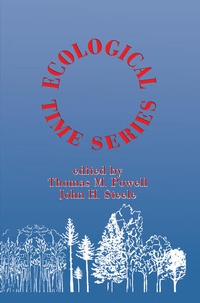
Ecological Time Series
Published on 31. December 1994
Book
Paperback/Softback
XVIII, 494 pages
978-0-412-05201-9 (ISBN)
Description
This book results from a summer school held at Cornell University in 1992. The participants were graduate students and postdoctoral researchers selected from a broad range of interests and backgrounds in ecological studies. The summer school was the second in a continuing series whose underlying aim and the aim of this volume-is to bring together the different methods and concepts underpinning terrestrial, freshwater, and marine ecology. The first volume in the series focused on patch dynamics in these three ecologi cal sectors. Here we have endeavored to complement that volume by extending its comparative approach to the consideration of ecological time series. The types of data and the methods of collection are necessarily very different in these contrasting environments, yet the underlying concept and the technical problems of analysis have much in common. It proved to be of great interest and value to the summer school participants to see the differences and then work through to an appreciation ofthe generalizable concepts. We believe that such an approach must have value as well for a much larger audience, and we have structured this volume to provide a comparable reading experience.
More details
Edition
1995
Language
English
Place of publication
New York
United States
Target group
Professional and scholarly
Research
Illustrations
35 s/w Abbildungen
XVIII, 494 p. 35 illus.
Dimensions
Height: 235 mm
Width: 155 mm
Thickness: 28 mm
Weight
768 gr
ISBN-13
978-0-412-05201-9 (9780412052019)
DOI
10.1007/978-1-4615-1769-6
Schweitzer Classification
Other editions
Additional editions
Thomas M. Powell | John H. Steele
Ecological Time Series
E-Book
12/2012
Springer
€96.29
Available for download
Content
I. Analysis and Methodology.- 1. Can Ecological Concepts Span the Land and Ocean Domains?.- 2. Fitting Population Models to Time Series Data.- 3. Estimate of Interhemispheric Ocean Carbon Transport Based on ?CO2 and Nutrient Distribution.- 4. Integration of Spatial Analysis in Long-Term Ecological Studies.- 5. Dynamical Systems Theory for Ecologists: A Brief Overview.- 6. The Natural History of Time Series.- 7. Detecting Periodicity in Quantitative versus Semi-Quantitative Times Series.- II. Comparisons of Scales.- 8. Physical and Biological Scales of Variability in Lakes, Estuaries, and the Coastal Ocean.- 9. Year-to-Year Fluctuation of the Spring Phytoplankton Bloom in South San Francisco Bay: An Example of Ecological Variability at the Land-Sea Interface.- 10. Scales of Variability in a Stable Environment: Phytoplankton in the Central North Pacific.- 11. Ocean Time Series Research Near Bermuda: The Hydrostation S Time-Series and the Bermuda Atlantic Time-Series Study (BATS) Program.- 12. Planning Long-Term Vegetation Studies at Landscape Scales.- 13. Time Series Compared Across the Land-Sea Gradient.- III. Processes and Principles.- 14. The Problem of Pattern and Scale in Ecology.- 15. Long-Term Environmental Change.- 16. Monitoring Ocean Productivity by Assimilating Satellite Chlorophyll into Ecosystem Models.- 17. Long-Term Measurements at the Arctic LTER Site.- 18. Basic Models in Epidemiology.- 19. The Invisible Present.- 20. Interpreting Explanatory Processes for Time Series Patterns: Lessons from Three Time Series.