

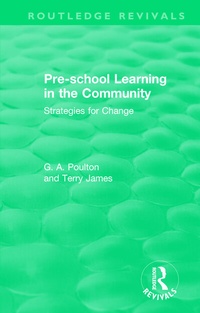
Pre-school Learning in the Community
Strategies for Change
1st Edition
Published on 27. August 2019
Book
Paperback/Softback
142 pages
978-1-138-48825-0 (ISBN)
Description
Much of current educational theory and research at the time was concerned with the effect that pre-school education should have in accelerating development throughout the years of compulsory schooling. This book, originally published in 1975, is an important contribution to the debate since it shows how the stages of pre-schooling affect the child, the family and the neighbourhood community.
The authors point out that pre-school stands at the intersection between the informal socialisation of the home and the more disciplined learning which takes place at school. Much research appears to show that poor progress in primary school results partly from adverse family circumstances; but it reveals just as plausibly that the formal measures of progress used by both the research and our schools are reflecting a limited view of progress and one which does least justice to the norms and values of families which do not share established academic goals. For this reason a cultural shock is experienced by many children on joining school. The authors argue that pre-school, as a transitional phase, could do much to reduce the shock, but that many of the efforts made for the under-fives simply expose them earlier to the contrast between home and school learning situations. They recognise that parents are educators and play a prominent part in the intellectual and social development of their children. They also stress that the effect of pre-school children on the social or psychological well-being of parents and children will be limited unless it takes account of and reaches out to the community to which they belong. The authors offer several alternative approaches to pre-school organisation and content of the time and examine some specific examples, such as the Pre-school Playgroup movement and the Leicester Home-Start scheme.
The book arose out of the authors' participation in several educational projects, including the Educational Priority Area Project which ran for three years during 1969-71. In particular it draws on their working experience which was based at the Red House Education Centre in a South Yorkshire mining community near Doncaster.
The authors point out that pre-school stands at the intersection between the informal socialisation of the home and the more disciplined learning which takes place at school. Much research appears to show that poor progress in primary school results partly from adverse family circumstances; but it reveals just as plausibly that the formal measures of progress used by both the research and our schools are reflecting a limited view of progress and one which does least justice to the norms and values of families which do not share established academic goals. For this reason a cultural shock is experienced by many children on joining school. The authors argue that pre-school, as a transitional phase, could do much to reduce the shock, but that many of the efforts made for the under-fives simply expose them earlier to the contrast between home and school learning situations. They recognise that parents are educators and play a prominent part in the intellectual and social development of their children. They also stress that the effect of pre-school children on the social or psychological well-being of parents and children will be limited unless it takes account of and reaches out to the community to which they belong. The authors offer several alternative approaches to pre-school organisation and content of the time and examine some specific examples, such as the Pre-school Playgroup movement and the Leicester Home-Start scheme.
The book arose out of the authors' participation in several educational projects, including the Educational Priority Area Project which ran for three years during 1969-71. In particular it draws on their working experience which was based at the Red House Education Centre in a South Yorkshire mining community near Doncaster.
More details
Series
Language
English
Place of publication
London
United Kingdom
Publishing group
Taylor & Francis Ltd
Target group
College/higher education
Professional and scholarly
Dimensions
Height: 216 mm
Width: 138 mm
Weight
260 gr
ISBN-13
978-1-138-48825-0 (9781138488250)
Copyright in bibliographic data and cover images is held by Nielsen Book Services Limited or by the publishers or by their respective licensors: all rights reserved.
Schweitzer Classification
Other editions
Additional editions

E-Book
10/2018
1st Edition
Routledge
€45.99
Available for download

E-Book
10/2018
Routledge
€45.99
Available for download
Book
01/2018
1st Edition
Routledge
€165.00
Shipment within 10-20 days
Persons
Terry James, G. A. Poulton
Content
Preface. Acknowledgments. Part 1: Research and Development in Early Education 1. Criteria for Success or Failure 2. Intervention and Innovation Part 2: Pre-school and the Community 3. A Case Study: The Red House Pre-school Groups 4. A Structured Approach to Early Education 5. Networks for Learning: Educative Processes within the Community 6. New Directions in Early Education 7. In Conclusion. Notes. Index.