

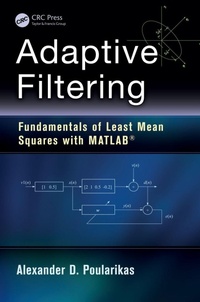
Adaptive Filtering
Fundamentals of Least Mean Squares with MATLAB (R)
1st Edition
Published on 26. September 2014
Book
Paperback/Softback
364 pages
978-1-4822-5335-1 (ISBN)
Description
Adaptive filters are used in many diverse applications, appearing in everything from military instruments to cellphones and home appliances. Adaptive Filtering: Fundamentals of Least Mean Squares with MATLAB (R) covers the core concepts of this important field, focusing on a vital part of the statistical signal processing area-the least mean square (LMS) adaptive filter.
This largely self-contained text:
Discusses random variables, stochastic processes, vectors, matrices, determinants, discrete random signals, and probability distributions
Explains how to find the eigenvalues and eigenvectors of a matrix and the properties of the error surfaces
Explores the Wiener filter and its practical uses, details the steepest descent method, and develops the Newton's algorithm
Addresses the basics of the LMS adaptive filter algorithm, considers LMS adaptive filter variants, and provides numerous examples
Delivers a concise introduction to MATLAB (R), supplying problems, computer experiments, and more than 110 functions and script files
Featuring robust appendices complete with mathematical tables and formulas, Adaptive Filtering: Fundamentals of Least Mean Squares with MATLAB (R) clearly describes the key principles of adaptive filtering and effectively demonstrates how to apply them to solve real-world problems.
This largely self-contained text:
Discusses random variables, stochastic processes, vectors, matrices, determinants, discrete random signals, and probability distributions
Explains how to find the eigenvalues and eigenvectors of a matrix and the properties of the error surfaces
Explores the Wiener filter and its practical uses, details the steepest descent method, and develops the Newton's algorithm
Addresses the basics of the LMS adaptive filter algorithm, considers LMS adaptive filter variants, and provides numerous examples
Delivers a concise introduction to MATLAB (R), supplying problems, computer experiments, and more than 110 functions and script files
Featuring robust appendices complete with mathematical tables and formulas, Adaptive Filtering: Fundamentals of Least Mean Squares with MATLAB (R) clearly describes the key principles of adaptive filtering and effectively demonstrates how to apply them to solve real-world problems.
More details
Language
English
Place of publication
Bosa Roca
United States
Publishing group
Taylor & Francis Inc
Target group
College/higher education
Applied scientists and engineers, as well as first-year graduate students.
Illustrations
129 s/w Abbildungen, 19 s/w Tabellen
19 Tables, black and white; 129 Illustrations, black and white
Dimensions
Height: 234 mm
Width: 156 mm
Thickness: 20 mm
Weight
553 gr
ISBN-13
978-1-4822-5335-1 (9781482253351)
Copyright in bibliographic data and cover images is held by Nielsen Book Services Limited or by the publishers or by their respective licensors: all rights reserved.
Schweitzer Classification
Other editions
Additional editions
E-Book
12/2017
CRC Press
€138.99
Available for download
E-Book
12/2017
CRC Press
€138.99
Available for download
Book
07/2017
1st Edition
CRC Press
€290.17
Shipment within 10-20 days
Person
Alexander D. Poularikas is chairman of the electrical and computer engineering department at the University of Alabama in Huntsville, USA. He previously held positions at University of Rhode Island, Kingston, USA and the University of Denver, Colorado, USA. He has published, coauthored, and edited 14 books and served as an editor-in-chief of numerous book series. A Fulbright scholar, lifelong senior member of the IEEE, and member of Tau Beta Pi, Sigma Nu, and Sigma Pi, he received the IEEE Outstanding Educators Award, Huntsville Section in 1990 and 1996. Dr. Poularikas holds a Ph.D from the University of Arkansas, Fayetteville, USA.
Content
Vectors. Matrices. Processing of Discrete Deterministic Signals: Discrete Systems. Discrete-Time Random Processes. The Wiener Filter. Eigenvalues of Rx: Properties of the Error Surface. Newton's and Steepest Descent Methods. The Least Mean-Square Algorithm. Variants of Least Mean-Square Algorithm. Appendices.