

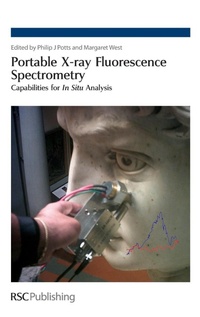
Portable X-ray Fluorescence Spectrometry
Capabilities for In Situ Analysis
Published on 29. July 2008
Book
Hardback
291 pages
978-0-85404-552-5 (ISBN)
Description
Portable X-ray fluorescence (PXRF) instrumentation has some unique analytical capabilities for the in situ analysis of samples in the field. These capabilities have been extended in recent years by the continuing development of solid state detectors, surface mounted electronics, digital signal processing technology, Li-ion batteries combined with a choice of rugged sealed radioisotope sources or miniature X-ray tubes that provide lightweight hand-held devices. As well as opening up new applications, in situ measurements by PXRF, where the instrument is placed in direct contact with the object to be analysed, involve the complete integration of sampling and analysis. Careful interpretation of results is therefore required, particularly when the analysis is used to estimate the bulk composition of a sample. In this monograph, an overview is given of instrumentation, analytical capabilities, and limitations in the interpretation of results, sampling considerations and applications where PXRF offers substantial advantages over conventional analytical techniques. The aim is to give the reader an insight into the capabilities of the technique and to demonstrate the contribution it can make to a range of areas of contemporary scientific interest. Chapters are written by internationally recognised scientists with practical experience of in situ analysis using portable X-ray fluorescence and demonstrates the wide range of applications for the technique. The topics covered are illustrated with diagrams and photographs where appropriate and each chapter includes supporting references to enable the reader to gain a greater understanding of a particular application. Topics include: -analytical capabilities -instrumentation -quantification -correction procedures -sampling considerations -future developments Applications include: -the assessment of contaminated land -surfaces -coatings and paints -workplace monitoring -metal & alloy sorting -geochemical prospecting -archaeological investigations -museum samples & works of art -extraterrestrial analysis The work is aimed at scientists who have some knowledge of analytical techniques and/or the applications covered, but are not fully familiar with the capabilities of PXRF. It offers a general introduction to the technique and its applications rather than a research monograph. As such, it is aimed at analytical scientists, environmental and geological scientists, industrial hygienists, industrial and plant scientists, archaeometrists and museum researchers, research scientists and research students with projects in the applications covered. Undergraduate students studying associated degree courses will also benefit from the work.
More details
Language
English
Place of publication
Cambridge
United Kingdom
Target group
College/higher education
Professional and scholarly
Product notice
Unsewn / adhesive bound
Dimensions
Height: 241 mm
Width: 162 mm
Thickness: 27 mm
Weight
611 gr
ISBN-13
978-0-85404-552-5 (9780854045525)
DOI
10.1039/9781847558640
Copyright in bibliographic data and cover images is held by Nielsen Book Services Limited or by the publishers or by their respective licensors: all rights reserved.
Schweitzer Classification
Other editions
Additional editions
Philip J. Potts | Margaret West
Portable X-ray Fluorescence Spectrometry
Capabilities for In Situ Analysis
E-Book
07/2008
1st Edition
Royal Society of Chemistry
€169.99
Available for download
Persons
Philip J Potts, Fellow of the Royal Society of Chemistry, is an analytical and chartered chemist with research interests in the development and application of techniques for the chemical analysis of geological and environmental samples. He has contributed to the analytical characterisation of the Beagle 2 XRF spectrometer; the development and application of portable XRF techniques to the characterisation of environmental (e.g. Pb in soil) and archaeological samples; the effect of weathering and surface roughness on PXRF quantification; the analytical data quality and proficiency testing and protocols for the characterisation of geological certified reference materials. He is also a Member of the Mineralogical Society, the Association of Exploration Geochemists, Association of University Radiation Protection Officers; President of the International Association of Geoanalysts, member of Executive Committee of Atomic Spectroscopy Updates (Journal of Analytical Atomic Spectroscopy), Member of the Instrumental Criteria Sub-committee (RSC) and Chair of Atomic Spectroscopy Group of the Royal Society of Chemistry. Margaret West is also an analytical chemist with experience in industrial and academic applications of X-ray spectrometry especially in manufacturing and associated raw materials industries. Recognised internationally for the development, application and training of X-ray analytical techniques she is also a Fellow of the Society of Glass Technology. She serves on national and international bodies responsible for the generation of certified reference materials and standard test methods for glass and other materials and is a Member of the Executive Committee of Atomic Spectroscopy Updates (Journal of Analytical Atomic Spectroscopy) and a Member of the Instrumental Criteria Sub-committee (RSC).
Content
Chapter 1: Introduction, analytical instrumentation and application overview;
Chapter 2: Quantification and correction procedures;
Chapter 3: Contaminated land: sampling considerations;
Chapter 4: Surfaces, coatings and paint;
Chapter 5: Hazardous Substances in the Workplace;
Chapter 6: Metal and alloy sorting;
Chapter 7: Geochemical prospecting;
Chapter 8: Archaeological lithic provenancing;
Chapter 9: Museum samples and works of art;
Chapter 10: Extraterrestrial Analysis : Planetary X-ray Fluorescence from Orbiting Spacecraft and Landers
Chapter 2: Quantification and correction procedures;
Chapter 3: Contaminated land: sampling considerations;
Chapter 4: Surfaces, coatings and paint;
Chapter 5: Hazardous Substances in the Workplace;
Chapter 6: Metal and alloy sorting;
Chapter 7: Geochemical prospecting;
Chapter 8: Archaeological lithic provenancing;
Chapter 9: Museum samples and works of art;
Chapter 10: Extraterrestrial Analysis : Planetary X-ray Fluorescence from Orbiting Spacecraft and Landers