

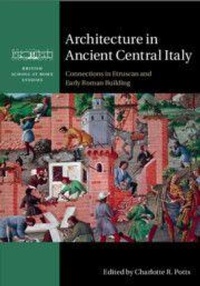
Architecture in Ancient Central Italy
Connections in Etruscan and Early Roman Building
Published on 21. December 2023
Book
Paperback/Softback
224 pages
978-1-108-93138-0 (ISBN)
Description
Architecture in Ancient Central Italy takes studies of individual elements and sites as a starting point to reconstruct a much larger picture of architecture in western central Italy as an industry, and to position the result in space (in the Mediterranean world and beyond) and time (from the second millennium BC to Late Antiquity). This volume demonstrates that buildings in pre-Roman Italy have close connections with Bronze Age and Roman architecture, with practices in local and distant societies, and with the natural world and the cosmos. It also argues that buildings serve as windows into the minds and lives of those who made and used them, revealing the concerns and character of communities in early Etruria, Rome, and Latium. Architecture consequently emerges as a valuable historical source, and moreover a part of life that shaped society as much as reflected it.
More details
Series
Language
English
Place of publication
Cambridge
United Kingdom
Target group
College/higher education
Edition type
New edition
Product notice
Paperback (trade)
Illustrations
Worked examples or Exercises; 5 Maps; 42 Halftones, color
Dimensions
Height: 244 mm
Width: 170 mm
Thickness: 12 mm
Weight
363 gr
ISBN-13
978-1-108-93138-0 (9781108931380)
Copyright in bibliographic data and cover images is held by Nielsen Book Services Limited or by the publishers or by their respective licensors: all rights reserved.
Schweitzer Classification
Other editions
Additional editions
Charlotte R. Potts
Architecture in Ancient Central Italy
Connections in Etruscan and Early Roman Building
Book
04/2022
Cambridge University Press
€124.60
Shipment within 15-20 days
Person
Content
1. Introduction: building connections Charlotte R. Potts; 2. The silent roofing revolution: the Etruscan Tie-beam Truss Jean MacIntosh Turfa; 3. Architectural terracottas of central Italy within their wider Mediterranean context Nancy A. Winter; 4. The connective evidence for early Roman urbanism: terracottas and architectural accretion John Hopkins; 5. Connecting foundations and roofs: the Satricum sacellum and the S. Omobono sanctuary Patricia S. Lulof and Loes Opgenhaffen; 6. Architectural choices in Etruscan sacred areas: Tarquinia in its Mediterranean setting Giovanna Bagnasco Gianni; 7. Connections in death: Etruscan tomb architecture, c.800-400 BC Stephan Steingraeber.