

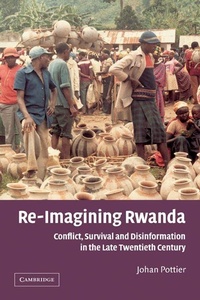
Re-Imagining Rwanda
Conflict, Survival and Disinformation in the Late Twentieth Century
Published on 26. September 2002
Book
Paperback/Softback
276 pages
978-0-521-52873-3 (ISBN)
Description
The tragic conflict in Rwanda and the Great Lakes in 1994-1996 attracted the horrified attention of the world's media. Journalists, diplomats and aid workers struggled to find a way to make sense of the bloodshed. Johan Pottier's troubling study shows that the post-genocide regime in Rwanda was able to impose a simple yet persuasive account of Central Africa's crises upon international commentators new to the region, and he explains the ideological underpinnings of this official narrative. He also provides a sobering analysis of the way in which this simple, persuasive, but fatally misleading analysis of the situation on the ground led to policy errors that exacerbated the original crisis. Professor Pottier has extensive field experience in the region, from before and after the genocide, and he has also worked among refugees in eastern Zaire.
Reviews / Votes
'... an important and courageous book, and well informed ... this analysis is essential reading for people interested in the area and in the role of the press in general'. Journal of African History 'In this courageous and important book, Pottier succeeds admirably in reaffirming the necessity of scholarly analysis, as enshrined in the academic monograph, to provide the basis for well-balanced and historically informed analyses of major events ... Pottier provides us with an insightful description of the build-up and aftermath of Rwanda's tragic genocide and ensuing war ... chapter 5 ... is a brilliant example of how the detailed anthropological understandings of a culture as lived by ordinary people can provide the best basis for understanding and interpreting larger and more complex events and (mis)representations at regional, national, and international levels. This important book should be required reading for anyone - from foreign diplomats and politicians, journalists, aid and development workers to academics - committed to building a better Rwanda, and for anyone whose task requires an engagement with the Great Lakes Region of Central Africa.' Journal of the Royal Anthropological Institute 'This is an important book on the political construction of knowledge ... it is essential reading for anyone interested in the conflicts of Central Africa, or complex humanitarian emergencies more generally.' African AffairsMore details
Series
Language
English
Place of publication
Cambridge
United Kingdom
Target group
Professional and scholarly
College/higher education
Product notice
Paperback (trade)
Illustrations
Worked examples or Exercises; 3 Maps; 3 Halftones, black and white; 3 Line drawings, black and white
Dimensions
Height: 229 mm
Width: 152 mm
Thickness: 16 mm
Weight
452 gr
ISBN-13
978-0-521-52873-3 (9780521528733)
Copyright in bibliographic data and cover images is held by Nielsen Book Services Limited or by the publishers or by their respective licensors: all rights reserved.
Schweitzer Classification
Other editions
Additional editions
Johan Pottier
Re-Imagining Rwanda
Conflict, Survival and Disinformation in the Late Twentieth Century
E-Book
12/2004
1st Edition
Cambridge University Press
€36.99
Available for download
Johan Pottier
Re-Imagining Rwanda
Conflict, Survival and Disinformation in the Late Twentieth Century
Book
09/2002
Cambridge University Press
€58.81
Article exhausted; check for reprint
Previous edition
Johan Pottier
Re-Imagining Rwanda
Conflict, Survival and Disinformation in the Late Twentieth Century
Book
09/2002
Cambridge University Press
€58.81
Article exhausted; check for reprint
Person
Johan Pottier is Professor of Social Anthropology at the School of Oriental and African Studies, University of London.
Content
1. Build-up to war and genocide: society and economy in Rwanda and Eastern Zaire; 2. Mind the gap: how the international press reported on society, politics and history; 3. For beginners, by beginners: knowledge construction under the Rwandese Patriotic Front; 4. Labelling refugees: international aid and the discourse of genocide; 5. Masterclass in surreal diplomacy: understanding the culture of 'political correctness'; 6. Land and social development: changes, proposals and their imagery; 7. Conclusion: representation and destiny; Bibliography.