

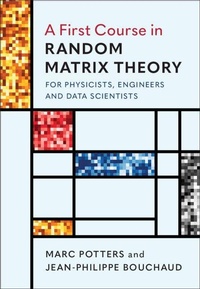
A First Course in Random Matrix Theory
for Physicists, Engineers and Data Scientists
Published on 3. December 2020
Book
Hardback
370 pages
978-1-108-48808-2 (ISBN)
Description
The real world is perceived and broken down as data, models and algorithms in the eyes of physicists and engineers. Data is noisy by nature and classical statistical tools have so far been successful in dealing with relatively smaller levels of randomness. The recent emergence of Big Data and the required computing power to analyse them have rendered classical tools outdated and insufficient. Tools such as random matrix theory and the study of large sample covariance matrices can efficiently process these big data sets and help make sense of modern, deep learning algorithms. Presenting an introductory calculus course for random matrices, the book focusses on modern concepts in matrix theory, generalising the standard concept of probabilistic independence to non-commuting random variables. Concretely worked out examples and applications to financial engineering and portfolio construction make this unique book an essential tool for physicists, engineers, data analysts, and economists.
More details
Language
English
Place of publication
Cambridge
United Kingdom
Illustrations
Worked examples or Exercises
Dimensions
Height: 253 mm
Width: 180 mm
Thickness: 27 mm
Weight
787 gr
ISBN-13
978-1-108-48808-2 (9781108488082)
Copyright in bibliographic data and cover images is held by Nielsen Book Services Limited or by the publishers or by their respective licensors: all rights reserved.
Schweitzer Classification
Other editions
Additional editions
E-Book
12/2020
Cambridge University Press
€53.99
Available for download
Marc Potters | Jean-Philippe Bouchaud
A First Course in Random Matrix Theory
for Physicists, Engineers and Data Scientists
E-Book
11/2020
Cambridge University Press
€57.99
Available for download
Persons
Marc Potters is Chief Investment Officer of CFM, an investment firm based in Paris. Marc maintains strong links with academia and as an expert in Random Matrix Theory, he has taught at UCLA and Sorbonne University. He is co-author of Theory of Financial Risk and Derivative Pricing (Cambridge 2003).
Content
Preface; Part I. Classical Random Matrix Theory: 1. Deterministic Matrices; 2. Wigner Ensemble and Semi-circle Law; 3. More on Gaussian Matrices; 4. Wishart Ensemble and Marcenko-Pastur Distribution; 5. Joint Distribution of Eigenvalues; 7. The Jacobi Ensemble; Part II. Sums and Products of Random Matrices: 8. Addition of Random Variables and Brownian Motion; 9. Dyson Brownian Motion; 10. Addition of Large Random Matrices; 11. Free Probabilities; 12. Free Random Matrices; 13. The Replica Method; 14. Edge Eigenvalues and Outliers; Part III. Applications: 15. Addition and Multiplication: Recipes and Examples; 16. Products of Many Random Matrices; 17. Sample Covariance Matrices; 18. Bayesian Estimation; 19. Eigenvector Overlaps and Rotationally Invariant Estimators; 20. Applications to Finance; Appendix A. Appendices: Mathematical Tools; List of Symbols; Index.