

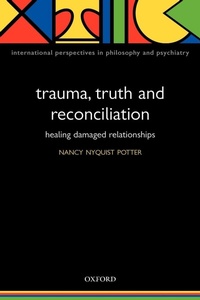
Trauma, Truth and Reconciliation
Healing damaged relationships
Published on 24. August 2006
Book
Paperback/Softback
316 pages
978-0-19-856943-5 (ISBN)
Description
People do great wrongs to each other all the time, sometimes deliberately, sometimes accidentally. Many within the fields of mental health are centrally involved in helping people to heal from traumatic events and to come to terms with wrongs done to them by others. However, there is surprisingly little in the way of guidance, few texts that situate healing from trauma or evildoing within a combined political and philosophical context. This book looks at how people, communities, and nations can address great wrongs and how they can heal from them - taking into consideration how differences in cultures, histories, and group expectations affect the possibilities for healing.
The book examines the merits of forgiveness and reconciliation in the context of civic and interpersonal relationships - looking at the role of the law compared to extra-legal and therapeutic approaches to individual and collective, personal and social, healing.
Topics include gendered norms for forgiveness, the role of narrative in contrast to a search for truth when conflicts arise, and an analysis of the conception of truth that undergirds truth and reconciliation commissions. Some chapters also look at how healing can occur when power imbalances exist, how to understand and address evil, genocide, and war. Finally, the book examines the importance of relational models of human interaction to thinking about trauma and healing, and how aboriginal models for healing can contribute to our understanding of trauma and forgiveness. Throughout, each contributor considers the psychological toll of trauma on both victims and perpetrators of wrongdoing and critically inquires into value systems that enhance or inhibit healing. Several authors draw on real-life cases to support their arguments, and others provide a rich theoretical framework within which readers can think through various approaches and models in a critical manner.
This highly original and thought-provoking collection of articles by authors in psychiatry, psychology, philosophy, and theology is unique in its emphasis on systems of oppression that intersect with anguish and moral uncertainty.
The book examines the merits of forgiveness and reconciliation in the context of civic and interpersonal relationships - looking at the role of the law compared to extra-legal and therapeutic approaches to individual and collective, personal and social, healing.
Topics include gendered norms for forgiveness, the role of narrative in contrast to a search for truth when conflicts arise, and an analysis of the conception of truth that undergirds truth and reconciliation commissions. Some chapters also look at how healing can occur when power imbalances exist, how to understand and address evil, genocide, and war. Finally, the book examines the importance of relational models of human interaction to thinking about trauma and healing, and how aboriginal models for healing can contribute to our understanding of trauma and forgiveness. Throughout, each contributor considers the psychological toll of trauma on both victims and perpetrators of wrongdoing and critically inquires into value systems that enhance or inhibit healing. Several authors draw on real-life cases to support their arguments, and others provide a rich theoretical framework within which readers can think through various approaches and models in a critical manner.
This highly original and thought-provoking collection of articles by authors in psychiatry, psychology, philosophy, and theology is unique in its emphasis on systems of oppression that intersect with anguish and moral uncertainty.
Reviews / Votes
This is not a handbook of 'How to do forgiveness', nor a self-help guide; rather, it is an exploration of why forgiveness seems so often to be a vital component of the healing process and of what happens when forgiveness does not happen. By combining insights from philosophy, sociology and psychology, this volume is a valuable addition to the literature on conflict, and a useful resource for anyone encountering traumatic situations where forgiveness may prove helpful in the journey towards recovery. * Mental Health Today * This is a book about a singularly important topic: how do we repair relationships after a wrong, often a wrong so severe that it cannot be simply rectified? How, after either personal or communal abuse or trauma, do we avoid the vortex of recrimination and retaliation? It is a book that deserves to be read slowly and taken seriously... an important book [that] should interest students and scholars of many disciplines. Most of all it should interest those concerned for the human condition. * Metapsychology Online Reviews *More details
Series
Language
English
Place of publication
Oxford
United Kingdom
Target group
Professional and scholarly
Dimensions
Height: 234 mm
Width: 156 mm
Thickness: 17 mm
Weight
483 gr
ISBN-13
978-0-19-856943-5 (9780198569435)
Copyright in bibliographic data and cover images is held by Nielsen Book Services Limited or by the publishers or by their respective licensors: all rights reserved.
Schweitzer Classification
Other editions
Additional editions
Book
08/2006
Oxford University Press
€160.40
Shipment within 15-20 days
Person
Nancy Nyquist Potter received her Ph.D. in Philosophy in 1994 from the University of Minnesota and she is currently an Associate Professor of Philosophy at the University of Louisville. Her research interests range from virtue ethics to the role of humor in conflict to philosophy and mental illness. She is Vice-President of the Association for the Advancement of Philosophy and Psychiatry, an Associate Editor for the journal Philosophy, Psychiatry, and Psychology, and serves on local hospital ethics committees and councils.
Content
1. Psychotherapy and the truth and reconcilation commission: the dialectic of individual and collective healing ; 2. Spiral of growth: a social psychiatric perspective on conflict resolution, reconciliation and relationship development ; 3. Reconciliation as compromise and the management of rage ; 4. Political reconciliation, the rule of law and post-traumatic stress disorder ; 5. When philosophical assumptions matter ; 6. How much truth and how much reconciliation? Intrapsychic, interpersonal and social aspects of resolution ; 7. Forgiveness: Beyond virtue and the law; on the moral significance of the act of forgiveness in Hegel's Phenomenology of Spirit ; 8. Elements of a phenomenology of evil and forgiveness ; 9. Forgiveness: a critical appraisal ; 10. Forgiveness therapy in gendered contexts: what happens to the truth? ; 11. Telling the truth about mental illness: the role of narrative ; 12. Healing relational trauma through relational means: aboriginal approaches