

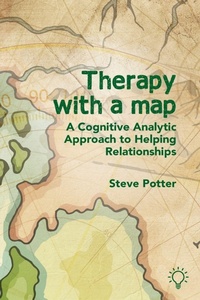
Therapy With A Map
A Cognitive Analytic Approach to Helping Relationships
Published on 31. July 2020
Book
Paperback/Softback
240 pages
978-1-912755-85-1 (ISBN)
Description
A therapeutic relationship is a web of interactions, tasks and processes in space and time. It is not easy to stay aware of the relationship in the thick of helping someone, but doing so boosts flexibility and enables deeper formulation. A therapist who can be attentive not only to activities specific to the model, but also to common factors underlying all therapy (or in simple terms, balance a task and person focus) has a far greater chance of enabling change. Building on thirty years of theory and practice in the field of Cognitive Analytic Therapy (CAT), yet speaking directly to practitioners across all therapeutic modalities, Brief Therapy Relationships explores the complex relationships that shape and contribute to therapeutic change. In doing so, it arms readers with a deeper understanding of what it means to be part of a therapeutic relationship, leading to increased control and confidence when working with clients.
More details
Language
English
Place of publication
Hove
United Kingdom
Target group
Professional and scholarly
Dimensions
Height: 234 mm
Width: 156 mm
Thickness: 14 mm
Weight
398 gr
ISBN-13
978-1-912755-85-1 (9781912755851)
Copyright in bibliographic data and cover images is held by Nielsen Book Services Limited or by the publishers or by their respective licensors: all rights reserved.
Schweitzer Classification
Person
STEVE POTTER is a psychotherapist who is teaches and supervises Cognitive Analytic Therapy (CAT) and its application to reflective practice in the UK and internationally. His central interest is in the co-creative process of relational mapping, and how it allows us to see and say things that otherwise might be too complex to hold in mind. He is co-editor of the International Journal of Cognitive Analytic Therapy and Relational Mental Health.
Content
Table of Contents
1. Introduction
Core concepts; stories from the therapy room
2. How to Have a Therapeutic Relationship
Talking and listening; within us and between us
3. Mapping, Writing, Other Methods of Relating
Mapping to hold and shape the therapy
4. Setting the Scene
Considerations for the therapist and client
5. Beginning to Work Together
Beginning therapeutic narrative; arriving at a focus
6. Establishing and maintaining a reformulation
Holding, shaping, monitoring; evaluating
7. What to do in the middle of therapy
Time, tasks, relationships; common problems
8. Ending
Managing the end of the relationship therapeutically
9. Therapeutic versatility
CAT as a framework for EMDR, Compassion-focused therapy, behavioural therapy, Gestalt therapy, groupwork, art therapy, authenticity
10. The therapeutic dance list: Tools for self-supervision and development
Relational competences and dimensions of relating
1. Introduction
Core concepts; stories from the therapy room
2. How to Have a Therapeutic Relationship
Talking and listening; within us and between us
3. Mapping, Writing, Other Methods of Relating
Mapping to hold and shape the therapy
4. Setting the Scene
Considerations for the therapist and client
5. Beginning to Work Together
Beginning therapeutic narrative; arriving at a focus
6. Establishing and maintaining a reformulation
Holding, shaping, monitoring; evaluating
7. What to do in the middle of therapy
Time, tasks, relationships; common problems
8. Ending
Managing the end of the relationship therapeutically
9. Therapeutic versatility
CAT as a framework for EMDR, Compassion-focused therapy, behavioural therapy, Gestalt therapy, groupwork, art therapy, authenticity
10. The therapeutic dance list: Tools for self-supervision and development
Relational competences and dimensions of relating