

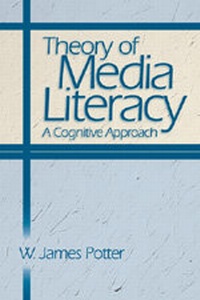
Theory of Media Literacy
A Cognitive Approach
1st Edition
Published on 24. June 2004
Book
Paperback/Softback
320 pages
978-0-7619-2952-9 (ISBN)
Description
Our society has become characterized by aggressive media. Information is constantly at our fingertips - whether it be through the books, newspapers, and magazines we read, the television we watch, the radio stations to which we listen, or the computers that connect us to the world in a matter of seconds. We can try to limit our media exposure, but it is impossible to avoid all media messages. As a result, we psychologically protect ourselves by automatically processing the media to which we are exposed.
Theory of Media Literacy: A Cognitive Approach comprehensively explains how we absorb the flood of information in our media-saturated society and examines how we often construct faulty meanings from those messages. In this book, author W. James Potter enlightens readers on the tasks of information processing. By building on a foundation of principles about how humans think, Theory of Media Literacy examines decisions about filtering messages, standard schema to match meaning, and higher level skills to construct meaning.
A central theme of Potter's theory is the locus that governs the degree to which a person is media literate. The locus is enriched by developing skills as well as good knowledge structures on five topics: media effects, media content, media industries, real world parameters, and the self.
Key Features
Presents the first social scientific theory of the process of media literacy
Explores a broad range of literature on media literacy written during the past two decades
Focuses on how the human mind works, especially in this mass media-saturated society
Theory of Media Literacy is an essential resource to a wide audience within the media discipline. The book provides empirical researchers with direction to test the theory and extend our understanding of how the media affect individuals and society. Practitioners will find it helpful in developing strategies to achieve goals and, at the same time, avoid high risks of negative effects. In addition, new scholars will find it to be an excellent introduction to various media literacy research.
Theory of Media Literacy: A Cognitive Approach comprehensively explains how we absorb the flood of information in our media-saturated society and examines how we often construct faulty meanings from those messages. In this book, author W. James Potter enlightens readers on the tasks of information processing. By building on a foundation of principles about how humans think, Theory of Media Literacy examines decisions about filtering messages, standard schema to match meaning, and higher level skills to construct meaning.
A central theme of Potter's theory is the locus that governs the degree to which a person is media literate. The locus is enriched by developing skills as well as good knowledge structures on five topics: media effects, media content, media industries, real world parameters, and the self.
Key Features
Presents the first social scientific theory of the process of media literacy
Explores a broad range of literature on media literacy written during the past two decades
Focuses on how the human mind works, especially in this mass media-saturated society
Theory of Media Literacy is an essential resource to a wide audience within the media discipline. The book provides empirical researchers with direction to test the theory and extend our understanding of how the media affect individuals and society. Practitioners will find it helpful in developing strategies to achieve goals and, at the same time, avoid high risks of negative effects. In addition, new scholars will find it to be an excellent introduction to various media literacy research.
More details
Edition
First Edition
Language
English
Place of publication
Thousand Oaks
United States
Target group
College/higher education
Professional and scholarly
Dimensions
Height: 229 mm
Width: 152 mm
Weight
425 gr
ISBN-13
978-0-7619-2952-9 (9780761929529)
Copyright in bibliographic data and cover images is held by Nielsen Book Services Limited or by the publishers or by their respective licensors: all rights reserved.
Schweitzer Classification
Other editions
Additional editions
Book
06/2004
1st Edition
SAGE Publications Inc
€184.90
Shipment within 15-20 days
Person
W. James Potter, professor at the University of California at Santa Barbara, holds one PhD in Communication Studies and another in Instructional Technology. He has been teaching media courses for more than two decades in the areas of effects on individuals and society, content narratives, structure and economics of media industries, advertising, and journalism. He has served as editor of the Journal of Broadcasting & Electronic Media and is the author of many journal articles and several dozen books, including: Media Effects; Media Literacy, 10th edition; The 11 Myths of Media Violence; Major Theories of Media Effects; Becoming a Strategic Thinker: Developing Skills for Success; and 7 Skills of Media Literacy.
Content
I. Background
Chapter 1: Why Do We Need a Theory of Media Literacy?
Chapter 2: Explicating the Construct of Media Literacy
II. Introducing the Theory
Chapter 3: Definitions and Distinctions
Chapter 4: The Media Literacy Model
Chapter 5: The Foundational Knowledge Structures
Chapter 6: The Personal Locus
Chapter 7: Competencies and Skills of Media Literacy
III. Information Processing
Chapter 8: The Filtering Task
Chapter 9: The Meaning-Matching Task
Chapter 10: The Meaning-Construction Task
Chapter 11: Traps in Meaning Construction
IV. Practices
Chapter12: Practices
Appendices
References
Preface
Chapter 1: Why Do We Need a Theory of Media Literacy?
Chapter 2: Explicating the Construct of Media Literacy
II. Introducing the Theory
Chapter 3: Definitions and Distinctions
Chapter 4: The Media Literacy Model
Chapter 5: The Foundational Knowledge Structures
Chapter 6: The Personal Locus
Chapter 7: Competencies and Skills of Media Literacy
III. Information Processing
Chapter 8: The Filtering Task
Chapter 9: The Meaning-Matching Task
Chapter 10: The Meaning-Construction Task
Chapter 11: Traps in Meaning Construction
IV. Practices
Chapter12: Practices
Appendices
References
Preface