

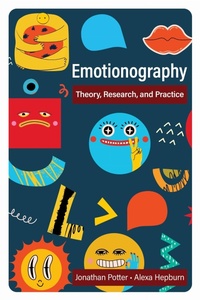
Emotionography
Theory, Research, and Practice
Will be published approx. on 31. May 2026
Book
Paperback/Softback
296 pages
978-1-4338-4270-2 (ISBN)
Description
How does emotion arise in everyday settings? How can it be studied in the real world?
In this book, authors Jonathan Potter and Alexa Hepburn offer their distinctive approach to the study of emotion. Emotionography explores emotion not through scales, experiments, or interviews, but as it actually occurs in natural interactions. Drawing on discursive psychology and conversation analysis, the authors' detailed analytic toolkit for representing talk, timing, and conduct makes visible how emotion is displayed, oriented to, and managed moment by moment. Step-by-step case examples show how crying and upset, laughter, and anger can be understood from an emotionographic perspective.
Emotion is live, consequential, and interactional, and it can be studied with a level of accuracy that also has practical bite. Emotionography shows how the ways people display and describe feelings shape what others do next, including how they respond, align, resist, comfort, escalate, or redirect. That matters in everyday life, and it matters in high-stakes settings such as helplines, emergency calls, healthcare, and counselling. Emotionography offers practitioners a way to refine how they respond in real time, and offers researchers a rigorous analytic alternative to treating emotion as a private inner state.
In this book, authors Jonathan Potter and Alexa Hepburn offer their distinctive approach to the study of emotion. Emotionography explores emotion not through scales, experiments, or interviews, but as it actually occurs in natural interactions. Drawing on discursive psychology and conversation analysis, the authors' detailed analytic toolkit for representing talk, timing, and conduct makes visible how emotion is displayed, oriented to, and managed moment by moment. Step-by-step case examples show how crying and upset, laughter, and anger can be understood from an emotionographic perspective.
Emotion is live, consequential, and interactional, and it can be studied with a level of accuracy that also has practical bite. Emotionography shows how the ways people display and describe feelings shape what others do next, including how they respond, align, resist, comfort, escalate, or redirect. That matters in everyday life, and it matters in high-stakes settings such as helplines, emergency calls, healthcare, and counselling. Emotionography offers practitioners a way to refine how they respond in real time, and offers researchers a rigorous analytic alternative to treating emotion as a private inner state.
Reviews / Votes
"Potter and Hepburn give us something psychologists seldom actually provide: investigations of people's actual behavior, in the settings that matter to them, and where the stakes are live and real. They do this through specifying, both theoretically and empirically, how emotion unfolds and matters moment to moment, in social interactions, and in its outcomes. Emotionography is essential reading for all those who study, research, and experience emotion." - Elizabeth Stokoe, PhD, Professor in Psychological and Behavioural Science, The London School of Economics and Political Science, London, United Kingdom"This trailblazing work opens an entirely new landscape of understanding and inquiry into the emotions. Potter and Hepburn move emotional study out of the laboratory and into real-life settings, where one can now begin to understand emotion's interdependent functioning in ongoing relationships. They also invite the reader's company, as they provide the necessary instruction for joining them in this distinctive form of research. An innovative and important book indeed." - Kenneth J. Gergen, PhD, Senior Research Professor, Swarthmore College, Swarthmore, PA, United States
"Seventy years ago, C. Wright Mills showed that the ascription of motives was an interactional process. Now Potter and Hepburn have done the same for emotions. This groundbreaking book makes visible the intricate practical life of emotion in our interactions." - David Silverman, PhD, Visiting Professor, Business School, Leeds University, Leeds, United Kingdom
"In Emotionography, the authors hand us a magnifying glass through which to see, in breathtaking detail, the expression of emotion as it occurs in situations both alarming and real. For professional and general readers alike, the book attunes us to emotion as a language through which we know what's going on, and through which we unwittingly speak. A very exciting contribution." - Arlie Russell Hochschild, PhD, author of The Managed Heart: Commercialization of Human Feeling
"A tour de force in persuasion. Potter and Hepburn had me at Chapter 1-with quotable gems that kept me smiling and my highlighter running. You will never experience, study, and conceptualize emotions the same way again." - Hansun Zhang Waring, EdD, Columbia University, New York, NY, United States
"Potter and Hepburn's groundbreaking book on emotionography provides a vivid and engaging account of how emotions are displayed and managed in everyday life using the most powerful interactional methods currently available: conversation analysis and discursive psychology. It will become essential reading for psychologists and social scientists who are seeking a fresh, innovative, and vital alternative to orthodox emotion research. This fascinating study of "emotions in the wild" is sure to be a game changer!" - Peter Muntigl, PhD, Ghent University, Ghent, Belgium
More details
Language
English
Place of publication
Washington DC
United States
Target group
College/higher education
Product notice
Paperback (trade)
Dimensions
Height: 229 mm
Width: 152 mm
Thickness: 17 mm
Weight
408 gr
ISBN-13
978-1-4338-4270-2 (9781433842702)
Copyright in bibliographic data and cover images is held by Nielsen Book Services Limited or by the publishers or by their respective licensors: all rights reserved.
Schweitzer Classification
Persons
Jonathan Potter, DPhil, is professor emeritus and former dean of the School of Communication and Information at Rutgers University-New Brunswick. Dr. Potter is one of the founders of discursive psychology which focuses on how careful analyses of interaction can be a route to the understanding and sometimes even reworking of basic psychological questions. Throughout his research career, Dr. Potter has addressed fundamental issues of theory and method, and he has made substantial research contributions in the area of language and racism, the operation of helplines, family interaction, and the way emotion and cognition operate in communication. He a member of the Academy of Social Sciences, a fellow of the International Communication Association and a Fellow of the British Psychological Society.
Alexa Hepburn, PhD, is professor emerita of communication at Rutgers University-New Brunswick. She has published widely on the science of human interaction, as well as on developments in discursive and critical psychology. Dr. Hepburn's research focuses on the use and development of conversation analytic methods, including the notation and analysis of emotional expression within social interaction; the interactional role of interrogatives such as tag questions; parents' strategies for managing their children's behavior; and the empirical grounding of these interests in everyday interaction. Her work highlights limitations in more traditional perspectives on emotion and influence, and supports applied work in professional client encounters including medical consultations, and helpline interactions. Dr. Hepburn also continues to develop and deliver training workshops to practitioners.
Alexa Hepburn, PhD, is professor emerita of communication at Rutgers University-New Brunswick. She has published widely on the science of human interaction, as well as on developments in discursive and critical psychology. Dr. Hepburn's research focuses on the use and development of conversation analytic methods, including the notation and analysis of emotional expression within social interaction; the interactional role of interrogatives such as tag questions; parents' strategies for managing their children's behavior; and the empirical grounding of these interests in everyday interaction. Her work highlights limitations in more traditional perspectives on emotion and influence, and supports applied work in professional client encounters including medical consultations, and helpline interactions. Dr. Hepburn also continues to develop and deliver training workshops to practitioners.
Content
Preface: A New Beginning for Emotion Research
Acknowledgments
1. Finding Emotion in Talk
2. Interactional Foundations of Emotionography: Conversation Analysis and Discursive Psychology
3. Crying and Upset
4. Laughter and Its Functions
5. Anger in the Wild
6. Principles and Practices of Emotionographic Research
7. Theory, Application, and Looking Forward
Appendix: Transcription Conventions
Selected Glossary of Technical Terms for Emotionography
References
Index
About the Authors
Acknowledgments
1. Finding Emotion in Talk
2. Interactional Foundations of Emotionography: Conversation Analysis and Discursive Psychology
3. Crying and Upset
4. Laughter and Its Functions
5. Anger in the Wild
6. Principles and Practices of Emotionographic Research
7. Theory, Application, and Looking Forward
Appendix: Transcription Conventions
Selected Glossary of Technical Terms for Emotionography
References
Index
About the Authors