

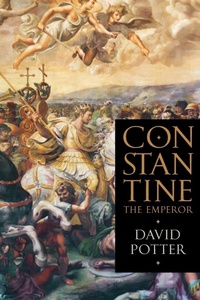
Constantine the Emperor
Published on 24. September 2015
Book
Paperback/Softback
384 pages
978-0-19-023162-0 (ISBN)
Description
No Roman emperor had a greater impact on the modern world than did Constantine. The reason is not simply that he converted to Christianity, but that he did so in a way that brought his subjects along after him. Indeed, this major new biography argues that Constantine's conversion is but one feature of a unique administrative style that enabled him to take control of an empire beset by internal rebellions and external threats by Persians and Goths. The vast record of Constantine's administration reveals a government careful in its exercise of power but capable of ruthless, even savage, actions. Constantine executed (or drove to suicide) his father-in-law, two brothers-in-law, his eldest son, and his once beloved wife. An unparalleled general throughout his life, planning a major assault on the Sassanian Empire in Persia even on his deathbed. Alongside the visionary who believed that his success came from the direct intervention of his God resided an aggressive warrior, a sometimes cruel partner, and an immensely shrewd ruler. These characteristics combined together in a long and remarkable career, which restored the Roman Empire to its former glory.
Beginning with his first biographer Eusebius, Constantine's image has been subject to distortion. More recent revisions include John Carroll's view of him as the intellectual ancestor of the Holocaust (Constantine's Sword) and Dan Brown's presentation of him as the man who oversaw the reshaping of Christian history (The Da Vinci Code). In Constantine the Emperor, David Potter confronts each of these skewed and partial accounts to provide the most comprehensive, authoritative, and readable account of Constantine's extraordinary life.
Beginning with his first biographer Eusebius, Constantine's image has been subject to distortion. More recent revisions include John Carroll's view of him as the intellectual ancestor of the Holocaust (Constantine's Sword) and Dan Brown's presentation of him as the man who oversaw the reshaping of Christian history (The Da Vinci Code). In Constantine the Emperor, David Potter confronts each of these skewed and partial accounts to provide the most comprehensive, authoritative, and readable account of Constantine's extraordinary life.
Reviews / Votes
The interested reader could find no better starting point for exploring the man and the era than David Potter's Constantine the Emperor. * Adrian Goldsworthy, The Wall Street Journal * A vividly detailed and energetically told biography. * Publishers Weekly * His narrative is crisp, clean and uncluttered [...] about men and events that have long been the subject of intensive, sometimes bitter controversy. * Peter Costello, The Irish Catholic * Constantine was a general of genius and a ruler and administrator of great ingenuity and efficiency. * Steve Craggs, The Northern Echo *More details
Language
English
Place of publication
New York
United States
Target group
College/higher education
Dimensions
Height: 234 mm
Width: 156 mm
Thickness: 21 mm
Weight
585 gr
ISBN-13
978-0-19-023162-0 (9780190231620)
Copyright in bibliographic data and cover images is held by Nielsen Book Services Limited or by the publishers or by their respective licensors: all rights reserved.
Schweitzer Classification
Other editions
Additional editions
David Potter
Constantine the Emperor
Book
02/2013
Oxford University Press Inc
€38.50
Shipment within 15-20 days
Person
David Potter is Francis W. Kelsey Collegiate Professor of Greek and Roman History and Arthur F. Thurnau Professor of Greek and Latin at the University of Michigan. His books include Theodora (OUP), The Victor's Crown (OUP), Emperors of Rome, and Ancient Rome: A New History
Content
Timeline ; Introduction ; Section 1 Imperial Resurrection ; Chapter 1 The Crisis of 260 ad ; Chapter 2 The Renewal of the Roman Empire ; Section 2 Diocletian ; Chapter 3 The New Emperor ; Chapter 4 Emperors and Subjects ; Chapter 5 A New Look ; Chapter 6 Persia and the Caesars ; Section 3 Constantine and Diocletian ; Chapter 7 The Court of Diocletian ; Chapter 8 Imperial Edicts and Moral Crusades ; Chapter 9 Minervina ; Chapter 10 The Succession ; Section 4 Fathers and Sons ; Chapter 11 The New Regime ; Chapter 12 Maxentius and Fausta ; Chapter 13 The End of Maximian ; Section 5 The Road to Rome ; Chapter 14 The Gathering Storm ; Chapter 15 The Battle of the Milvian Bridge ; Chapter 16 Freedom of Worship ; Chapter 17 The Conversion of Constantine ; Section 6 War and Peace ; Chapter 18 Reworking Past and Future ; Chapter 19 Governing the Empire ; Chapter 20 Maximus and Bassus 319-323 ; Chapter 21 The Donatist Controversy ; Section 7 Triumph and Tragedy ; Chapter 22 The Defeat of Licinius ; Chapter 23 The Eastern Empire ; Chapter 24 Constantine Speaks to the Bishops ; Chapter 25 The Arian Controversy ; Chapter 26 Nicaea ; Chapter 27 Constantinople and Rome ; Section 8 Ruler of the World ; Chapter 28 Constantine's Government ; Chapter 29 Constantinople ; Chapter 30 An Ordered Society ; Chapter 31 Christians, Pagans and Jews ; Chapter 32 Neighbours ; Chapter 33 End Times ; Epilogue ; Appendix ; Timeline ; Dramatis Personae ; Notes ; Bibliography ; Index