

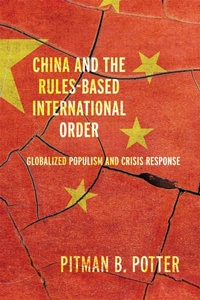
China and the Rules-Based International Order
Description
Drawing parallels with domestic populism movements that are anti-elitist and grievance-fuelled, China and the Rules-Based International Order theorizes that contemporary Chinese conduct under the leadership of Xi Jinping can be described as "globalized populism" against the Western-dominated international order.
Pitman B. Potter uses the framework of populism to explore China's responses to three global crises: the COVID-19 pandemic, climate change, and involuntary migration. As other countries debated the cause of COVID-19, China expressed an antagonistic populism in its relations with the international public health policy system. By contrast, the domestic challenges of climate change have prompted greater Chinese involvement in international climate policy, an example of participatory populism. Finally, China has responded hesitantly to migration, articulated in passive populism against international migration policy.
This reasoned analysis of China's globalized populism supports a better understanding of a country with increasing prominence in the world and suggests practical policies to improve relations between China and the international system.
More details
Person
Pitman B. Potter is Professor of Law Emeritus at the University of British Columbia and a former director of Chinese Legal Studies. He is a fellow of the Royal Society of Canada and a member of the Order of Canada, and practised law in BC, Washington state, and California throughout his academic career. Among his many publications is Exporting Virtue? China's International Human Rights Activism in the Age of Xi Jinping, as well as Assessing Treaty Performance in China: Trade and Human Rights and China's Legal System.