

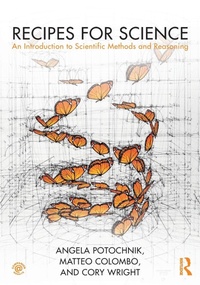
Recipes for Science
An Introduction to Scientific Methods and Reasoning
1st Edition
Published on 27. August 2018
Book
Paperback/Softback
348 pages
978-1-138-92073-6 (ISBN)
Description
Today, scientific literacy is an essential aspect of any undergraduate education. Recipes for Science responds to this need by providing an accessible introduction to the nature of science and scientific methods, reasoning, and concepts that is appropriate for any beginning college student. It is designed to be adaptable to a wide variety of different kinds of courses, such as introductions to scientific reasoning or critical thinking, philosophy of science, and science education. In any of these different uses, the book helps students better navigate our scientific, 21st-century world.
Key Features
Contemporary and historical examples of science from many fields of physical, life, and social sciences.
Visual aids to clarify and illustrate ideas.
Text boxes to explore related topics.
Plenty of exercises to ensure full student engagement and mastery of the information.
Annotated 'Further Reading' sections at the end of each chapter.
Final glossary with helpful definitions of key terms.
A companion website with author-developed and crowdsourced materials, including syllabi for courses using this textbook, bibliography of additional resources and online materials, sharable PowerPoint presentations and lecture notes, and additional exercises and extended projects.
Key Features
Contemporary and historical examples of science from many fields of physical, life, and social sciences.
Visual aids to clarify and illustrate ideas.
Text boxes to explore related topics.
Plenty of exercises to ensure full student engagement and mastery of the information.
Annotated 'Further Reading' sections at the end of each chapter.
Final glossary with helpful definitions of key terms.
A companion website with author-developed and crowdsourced materials, including syllabi for courses using this textbook, bibliography of additional resources and online materials, sharable PowerPoint presentations and lecture notes, and additional exercises and extended projects.
Reviews / Votes
". . . a wonderfully useful description of how science works. The examples are informative and effective. The exercises are imaginative, both thoughtful and thought-provoking. And the components of scientific method are clearly presented with enough detail to see not only how they work but both their strengths and limitations. All the tools are there. You probably knew what tools would be used, but with this book you will understand the variety and application with greater clarity and a better appreciation for the value of science. Recipes for Science will help you sharpen the tools and keep them sharp."Peter Kosso, in Science & Education
"More often than not students acquire content knowledge about science, deprived from any explicit reflection about the methods, the reasoning and the uncertainties that characterize it. Even laboratory activities can take the form of implementing a cookbook recipe, simply following predetermined steps towards a "correct" answer. But this is not how science is done. If there are recipes, they are open to creativity and they vary enormously. Recipes for Science excellently shows this and provides very useful materials for explicit reflection about the nature of science."
Kostas Kampourakis, University of Geneva, Switzerland
"Recipes for Science is clear and very readable, providing students with a solid philosophical background in issues surrounding scientific reasoning and methodologies, fleshed out with well-chosen, compelling examples. Either on its own, or as a basis from which to build, this will be a welcome text in scientific reasoning and philosophy of science classes."
Jonathan Michael Kaplan, Oregon State University ". . . a wonderfully useful description of how science works. The examples are informative and effective. The exercises are imaginative, both thoughtful and thought-provoking. And the components of scientific method are clearly presented with enough detail to see not only how they work but both their strengths and limitations. All the tools are there. You probably knew what tools would be used, but with this book you will understand the variety and application with greater clarity and a better appreciation for the value of science. Recipes for Science will help you sharpen the tools and keep them sharp."
Peter Kosso, in Science & Education
"More often than not students acquire content knowledge about science, deprived from any explicit reflection about the methods, the reasoning and the uncertainties that characterize it. Even laboratory activities can take the form of implementing a cookbook recipe, simply following predetermined steps towards a "correct" answer. But this is not how science is done. If there are recipes, they are open to creativity and they vary enormously. Recipes for Science excellently shows this and provides very useful materials for explicit reflection about the nature of science."
Kostas Kampourakis, University of Geneva, Switzerland
"Recipes for Science is clear and very readable, providing students with a solid philosophical background in issues surrounding scientific reasoning and methodologies, fleshed out with well-chosen, compelling examples. Either on its own, or as a basis from which to build, this will be a welcome text in scientific reasoning and philosophy of science classes."
Jonathan Michael Kaplan, Oregon State University
More details
Language
English
Place of publication
London
United Kingdom
Publishing group
Taylor & Francis Ltd
Target group
College/higher education
Illustrations
20 s/w Photographien bzw. Rasterbilder, 20 s/w Zeichnungen, 22 s/w Tabellen
22 Tables, black and white; 20 Line drawings, black and white; 20 Halftones, black and white
Dimensions
Height: 254 mm
Width: 178 mm
Thickness: 19 mm
Weight
659 gr
ISBN-13
978-1-138-92073-6 (9781138920736)
Copyright in bibliographic data and cover images is held by Nielsen Book Services Limited or by the publishers or by their respective licensors: all rights reserved.
Schweitzer Classification
Other editions
New editions
Angela Potochnik | Matteo Colombo | Cory Wright
Recipes for Science
An Introduction to Scientific Methods and Reasoning
Book
04/2024
2nd Edition
Routledge
€57.00
Shipment within 10-20 days
Additional editions
Angela Potochnik | Matteo Colombo | Cory Wright
Recipes for Science
An Introduction to Scientific Methods and Reasoning
Book
09/2018
1st Edition
Routledge
€215.41
Article exhausted; check for reprint
Persons
Angela Potochnik is Associate Professor of Philosophy and Director of the Center for Public Engagement with Science at the University of Cincinnati, USA.
Matteo Colombo is Assistant Professor in the Tilburg Center for Logic, Ethics, and Philosophy of Science, and in the Department of Philosophy at Tilburg University, the Netherlands.
Cory Wright is Professor of Philosophy and Director of Graduate Studies at California State University Long Beach, USA.
Matteo Colombo is Assistant Professor in the Tilburg Center for Logic, Ethics, and Philosophy of Science, and in the Department of Philosophy at Tilburg University, the Netherlands.
Cory Wright is Professor of Philosophy and Director of Graduate Studies at California State University Long Beach, USA.
Content
List of Figures; Acknowledgements; Introduction: Science and Your Everyday Life; Chapter 1. What is Science?; 1.1 The Importance of Science; 1.2 Defining Science; 1.3 Recipes for Science; Chapter 2. Experiments and Studies; 2.1 Experiment: Connecting Hypotheses to Observations; 2.2 The Perfectly Controlled Experiment; 2.3 Experimental and Non-Experimental Methods; Chapter 3. Models and Modeling; 3.1 Models in Science; 3.2 Varieties of Models; 3.3 Learning from Models; Chapter 4. Patterns of Interference; 4.1 Deductive Reasoning; 4.2 Deductive Reasoning in Hypothesis-Testing; 4.3 Inductive and Abductive Reasoning; 5. Statistics and Probability; 5.1 The Roles of Statistics and Probability; 5.2 Basic Probability Theory; 5.3 Descriptive Statistics; Chapter 6. Statistical Inference; 6.1 Generalizing from Descriptive Statistics; 6.2 Using Statistics to Test Hypotheses; 6.3 A Different Approach to Statistical Inference; Chapter 7. Causal Reasoning; 7.1 What is Causation?; 7.2 Testing Causal Hypotheses; 7.3 Causal Modeling; Chapter 8. Explanations, Theories, and Values; 8.1 Understanding the World; 8.2 Theories and Theory Change; 8.3 Science, Society, and Values; Glossary; References; Index