

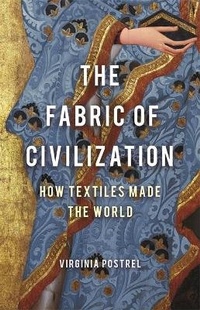
The Fabric of Civilization
How Textiles Made the World
Published on 12. November 2020
Book
Hardback
320 pages
978-1-5416-1760-5 (ISBN)
Description
The story of humanity is the story of textiles-as old as civilization itself. Textiles created empires and powered invention. They established trade routes and drew nations' borders. Since the first thread was spun, fabric has driven technology, business, politics, and culture.
In The Fabric of Civilization, Virginia Postrel traces this surprising history, exposing the hidden ways textiles have made our world. The origins of chemistry lie in the coloring and finishing of cloth. The beginning of binary code-and perhaps all of mathematics-is found in weaving. Selective breeding to produce fibers heralded the birth of agriculture. The belt drive came from silk production. So did microbiology. The textile business funded the Italian Renaissance and the Mughal Empire; it left us double-entry bookkeeping and letters of credit, the David and the Taj Mahal. From the Minoans who exported woolen cloth colored with precious purple dye to Egypt, to the Romans who wore wildly expensive Chinese silk, the trade and production of textiles paved the economic and cultural crossroads of the ancient world. As much as spices or gold, the quest for fabrics and dyes drew sailors across strange seas, creating an ever-more connected global economy.
Synthesizing groundbreaking research from economics, archaeology, and anthropology, Postrel weaves a rich tapestry of human cultural development.
In The Fabric of Civilization, Virginia Postrel traces this surprising history, exposing the hidden ways textiles have made our world. The origins of chemistry lie in the coloring and finishing of cloth. The beginning of binary code-and perhaps all of mathematics-is found in weaving. Selective breeding to produce fibers heralded the birth of agriculture. The belt drive came from silk production. So did microbiology. The textile business funded the Italian Renaissance and the Mughal Empire; it left us double-entry bookkeeping and letters of credit, the David and the Taj Mahal. From the Minoans who exported woolen cloth colored with precious purple dye to Egypt, to the Romans who wore wildly expensive Chinese silk, the trade and production of textiles paved the economic and cultural crossroads of the ancient world. As much as spices or gold, the quest for fabrics and dyes drew sailors across strange seas, creating an ever-more connected global economy.
Synthesizing groundbreaking research from economics, archaeology, and anthropology, Postrel weaves a rich tapestry of human cultural development.
More details
Language
English
Place of publication
United States
Target group
College/higher education
Professional and scholarly
Illustrations
92 Illustrations, black & white and 3 Charts
Dimensions
Height: 238 mm
Width: 152 mm
Thickness: 36 mm
Weight
512 gr
ISBN-13
978-1-5416-1760-5 (9781541617605)
Copyright in bibliographic data and cover images is held by Nielsen Book Services Limited or by the publishers or by their respective licensors: all rights reserved.
Schweitzer Classification
Other editions
Additional editions
E-Book
11/2020
Basic Books
€11.99
Available for download
Person
Virginia Postrel is an award-winning journalist and independent scholar. She is a columnist for Bloomberg Opinion and has been a columnist for the Atlantic, the Wall Street Journal, and the New York Times. She is the author of the highly acclaimed The Substance of Style and The Power of Glamour. Her research is supported by the Alfred P. Sloan Foundation. She lives in Los Angeles, California.