

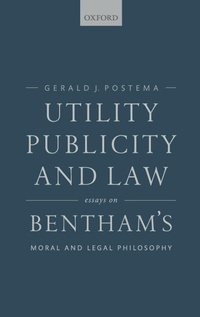
Utility, Publicity, and Law
Essays on Bentham's Moral and Legal Philosophy
Published on 29. July 2019
Book
Hardback
336 pages
978-0-19-879317-5 (ISBN)
Description
The essays in this volume offer a reassessment of Jeremy Bentham's strikingly original legal philosophy. Early on, Bentham discovered his 'genius for legislation' - 'legislation' included not only lawmaking and code writing, but also political and social institution building and engineering of public spaces for effective control of the exercise of political power. In his general philosophical work, Bentham sought to articulate a public philosophy to guide and direct all of his 'legislative' efforts.
Part I explores the philosophical foundations of his public philosophy: his theory of meaning and framework for analysis and definition of key concepts, his theory of human affections and motivations, and his utilitarian theory of value. It is argued that, while concepts of pleasure and happiness play nominal roles in his theory of value, concepts of publicity, equality, and interests emerge as the dominant concepts of his public philosophy. Part II explores several dimensions of Bentham's jurisprudence, including his radically revised command model of law, his early reflections on justice and law in adjudication, his theories of judicial evidence, constitutional rights, the rule of law, and international law. The concluding essay demonstrates the centrality of the notion of publicity in his moral, legal and political thought. Emerging from this study is a positivist legal theory and a utilitarian moral-political philosophy that challenge in fundamental ways contemporary understandings of those doctrines.
Part I explores the philosophical foundations of his public philosophy: his theory of meaning and framework for analysis and definition of key concepts, his theory of human affections and motivations, and his utilitarian theory of value. It is argued that, while concepts of pleasure and happiness play nominal roles in his theory of value, concepts of publicity, equality, and interests emerge as the dominant concepts of his public philosophy. Part II explores several dimensions of Bentham's jurisprudence, including his radically revised command model of law, his early reflections on justice and law in adjudication, his theories of judicial evidence, constitutional rights, the rule of law, and international law. The concluding essay demonstrates the centrality of the notion of publicity in his moral, legal and political thought. Emerging from this study is a positivist legal theory and a utilitarian moral-political philosophy that challenge in fundamental ways contemporary understandings of those doctrines.
More details
Language
English
Place of publication
Oxford
United Kingdom
Target group
Professional and scholarly
Dimensions
Height: 240 mm
Width: 161 mm
Thickness: 22 mm
Weight
661 gr
ISBN-13
978-0-19-879317-5 (9780198793175)
Copyright in bibliographic data and cover images is held by Nielsen Book Services Limited or by the publishers or by their respective licensors: all rights reserved.
Schweitzer Classification
Other editions
Additional editions
E-Book
07/2019
1st Edition
OUP eBook
€70.99
Available for download
E-Book
07/2019
1st Edition
OUP eBook
€70.99
Available for download
Person
Gerald J. Postema (born Chicago, 1948), is Professor Emeritus of Philosophy at University of North Carolina at Chapel Hill. He is a Fellow of Corpus Christi College, Cambridge; Guggenheim Fellow (2005-6); Rockefeller Fellow, Bellagio (2001); Fellow of the Netherland Institute for Advanced Studies (1996-7). He has held visiting posts at the European University Institute (Florence), University of Athens, Yale University, and University of California, Berkeley. BA: Calvin College; PhD: Cornell University (1976).
Content
PART I: FOUNDATIONS
1: Meaning, Analysis, and Exposition: The Technology of Thought
2: Human Psychology, Individual, and Social
3: Normative Theory: The Principle of Utility
4: Publicity and the Development of Bentham's Theory of Value
5: Bentham's Equality-Sensitive Theory of Value
6: Interests: Universal and Particular
PART II: JURISPRUDENCE
7: Utility, Public Rules, and Common-Law Adjudication
8: Utility and Command: Roots of Bentham's Universal Jurisprudence
9: Facts, Fictions, and Law: Foundations of the Law of Evidence
10: In Defense of
1: Meaning, Analysis, and Exposition: The Technology of Thought
2: Human Psychology, Individual, and Social
3: Normative Theory: The Principle of Utility
4: Publicity and the Development of Bentham's Theory of Value
5: Bentham's Equality-Sensitive Theory of Value
6: Interests: Universal and Particular
PART II: JURISPRUDENCE
7: Utility, Public Rules, and Common-Law Adjudication
8: Utility and Command: Roots of Bentham's Universal Jurisprudence
9: Facts, Fictions, and Law: Foundations of the Law of Evidence
10: In Defense of