

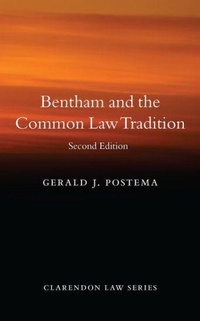
Bentham and the Common Law Tradition
2nd Edition
Published on 30. July 2019
Book
Hardback
564 pages
978-0-19-879305-2 (ISBN)
Description
This work explores the relationship between Bentham's utilitarian practical philosophy and his positivist jurisprudence. These theories appear to be in tension because his utilitarian commitment to the sovereignty of utility as a practical decision principle seems inconsistent with his positivist insistence on the sovereignty of the will of the lawmaker.
Two themes emerge from the attempt in this work to reconcile these two core elements of Bentham's practical thought. First, Bentham's conception of law does not fit the conventional model of legal positivism. Bentham was not just a utilitarian and a positivist; he was a positivist by virtue of his commitment to a utilitarian understanding of the fundamental task of law. Moreover, his emphasis on the necessary publicity and the systemic character of law, led him to insist on an essential role for utilitarian reasons in the regular public functioning of law. Second, Bentham's radical critique of common law theory and practice convinced him of the necessity to reconcile the need for certainty of law with an equally great need for its flexibility. He eventually developed a constitutional framework for adjudication in the shadow of codified law that accorded to judges discretion to decide particular cases according to their best judgment of the balance of utilities, guaranteeing the accountability and appropriate motivation of judicial decision-making through institutional incentives.
The original text of this work, first published in 1986, remains largely unchanged, but an afterword reconsiders and revises some themes in response to criticism.
Two themes emerge from the attempt in this work to reconcile these two core elements of Bentham's practical thought. First, Bentham's conception of law does not fit the conventional model of legal positivism. Bentham was not just a utilitarian and a positivist; he was a positivist by virtue of his commitment to a utilitarian understanding of the fundamental task of law. Moreover, his emphasis on the necessary publicity and the systemic character of law, led him to insist on an essential role for utilitarian reasons in the regular public functioning of law. Second, Bentham's radical critique of common law theory and practice convinced him of the necessity to reconcile the need for certainty of law with an equally great need for its flexibility. He eventually developed a constitutional framework for adjudication in the shadow of codified law that accorded to judges discretion to decide particular cases according to their best judgment of the balance of utilities, guaranteeing the accountability and appropriate motivation of judicial decision-making through institutional incentives.
The original text of this work, first published in 1986, remains largely unchanged, but an afterword reconsiders and revises some themes in response to criticism.
Reviews / Votes
A magnificent achievement, and one of the best books ever written on legal theory. Postema brilliantly explores the conflict between the common law and Benthamite utilitarianism, with enduring lessons for both theory and practice. * Cass R. Sunstein, Robert Walmsley University Professor, Harvard University * When Postema's book was published in 1989, it brought Jeremy Bentham's jurisprudence to life and it gave us new ways of understanding legal positivism. Thirty years later, its importance is undiminished. This is a fine thoughtful meditation on Bentham's legal theory and his critique of eighteenth-century common law. * Jeremy Waldron, University Professor and Professor of Law, New York University * Scholars have much to thank Professor Postema for, in mapping out so clearly the relationship between Bentham's thoughts on substantive law and procedure, and for placing it so firmly in the context of eighteenth century common law thought. It is rare to find a book which changes the way one thinks about great jurists: this is one such book. * The Cambridge Law Journal *More details
Series
Edition
2nd Revised edition
Language
English
Place of publication
Oxford
United Kingdom
Target group
Professional and scholarly
Edition type
Revised edition
Product notice
sewn/stitched
Cloth over boards
Dimensions
Height: 218 mm
Width: 147 mm
Thickness: 41 mm
Weight
816 gr
ISBN-13
978-0-19-879305-2 (9780198793052)
Copyright in bibliographic data and cover images is held by Nielsen Book Services Limited or by the publishers or by their respective licensors: all rights reserved.
Schweitzer Classification
Other editions
Additional editions
Gerald J. Postema
Bentham and the Common Law Tradition
E-Book
12/2019
2nd Edition
OUP eBook
€86.99
Available for download
Gerald J. Postema
Bentham and the Common Law Tradition
E-Book
12/2019
2nd Edition
OUP eBook
€75.99
Available for download
Gerald J. Postema
Bentham and the Common Law Tradition
Book
01/1989
Clarendon Press
€45.87
Article exhausted; check for reprint
Previous edition
Gerald J. Postema
Bentham and the Common Law Tradition
Book
01/1989
Clarendon Press
€45.87
Article exhausted; check for reprint
Person
Gerald J. Postema is Professor Emeritus of Philosophy at the University of North Carolina at Chapel Hill. He is a Fellow of Corpus Christi College, Cambridge; a Guggenheim Fellow (2005-6); a Rockefeller Fellow, Bellagio (2001); and a Fellow of the Netherland Institute for Advanced Studies (1996-7). He has held visiting posts at the University of Cambridge, the European University Institute (Florence), the University of Athens, Yale University, and the University of California, Berkeley.
Content
Part I: Law, Custom, and Reason
1: Elements of Classical Common Law Theory
2: Law, Social Union, and Collective Rationality
3: Hume's Jurisprudence: Law, Justice, and Human Nature
4: Hume's Jurisprudence: Common Law Conventionalism
Part II Bentham's Critique of Common Law: The Roots of Positivism
5: Utilitarian Justice and the Tasks of Law
6: Bentham as a Common Law Revisionist
7: Custom, Rules, and Sovereignty
8: Plucking Off the Mask of Mystery
9: Utilitarian Positivism
Part III: Law, Utility, and Adjudication
10: The Judge as Paterfamilias
11: Judicial Virtues and the Sanctions of Public Opinion
12: Utilitarian Adjudication within the Shadow of the Code
13: The Coherence of Bentham's Theory of Law
1: Elements of Classical Common Law Theory
2: Law, Social Union, and Collective Rationality
3: Hume's Jurisprudence: Law, Justice, and Human Nature
4: Hume's Jurisprudence: Common Law Conventionalism
Part II Bentham's Critique of Common Law: The Roots of Positivism
5: Utilitarian Justice and the Tasks of Law
6: Bentham as a Common Law Revisionist
7: Custom, Rules, and Sovereignty
8: Plucking Off the Mask of Mystery
9: Utilitarian Positivism
Part III: Law, Utility, and Adjudication
10: The Judge as Paterfamilias
11: Judicial Virtues and the Sanctions of Public Opinion
12: Utilitarian Adjudication within the Shadow of the Code
13: The Coherence of Bentham's Theory of Law