

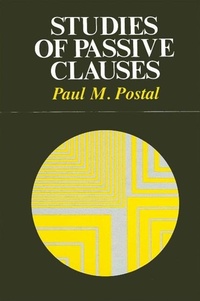
Studies of Passive Clauses
Will be published approx. on 1. November 1985
Book
Hardback
286 pages
978-0-88706-083-0 (ISBN)
Description
In this work, Paul M. Postal supports the universalist theory of language by examining passive clauses. Contrary to a skeptical tradition, Postal argues that passive clauses are cross-linguistically identifiable and characterizable. This study proposes refinements of the analysis of the natural language grammatical category Passive Clause. These refinements include an account of the notion 'dummy nominal,' central to the analysis of impersonal passive clauses; additions permitting a proper typology of the major known subtypes of Passive Clause; a generalization permitting application to clauses whose subjects are not earlier level direct objects; and, construction of precise rule concepts to represent restrictions on passive clauses.
The passive domain supports the universalist approach in three distinguishable ways: (1) by permitting formulation of otherwise apparently unstatable lawful characteristics of all passive structures; (2) by facilitating statement of language-specific passive constraints holding in diverse languages; and, (3) by allowing uniform statement in grammars of recurrent constraints on passives. Each mode of support is applied to actual cases based on material from more than a dozen languages from English and French to Quiche (Mayan) and Chi-Mwi:ni (Bantu).
The passive domain supports the universalist approach in three distinguishable ways: (1) by permitting formulation of otherwise apparently unstatable lawful characteristics of all passive structures; (2) by facilitating statement of language-specific passive constraints holding in diverse languages; and, (3) by allowing uniform statement in grammars of recurrent constraints on passives. Each mode of support is applied to actual cases based on material from more than a dozen languages from English and French to Quiche (Mayan) and Chi-Mwi:ni (Bantu).
Reviews / Votes
"It will be the best introduction to arc pair grammar (APG) available, and as such will be a standard work for anyone who wishes to learn something about this framework." - Geoffrey K. Pullum, Cowell College, University of California at Santa Cruz"Postal provides a detailed crosslinguistic account of a construction-type that has long been at the center of syntactic investigation but has resisted real explanation so far. The book will be of great interest to anyone working on grammatical relations, regardless of their particular theoretical leanings." - Mark Aronoff, State University of New York at Stony Brook
More details
Language
English
Place of publication
Albany, NY
United States
Target group
Professional and scholarly
US School Grade: College Graduate Student and over
Product notice
sewn/stitched
Cloth over boards
Dimensions
Height: 229 mm
Width: 152 mm
Weight
535 gr
ISBN-13
978-0-88706-083-0 (9780887060830)
Copyright in bibliographic data and cover images is held by Nielsen Book Services Limited or by the publishers or by their respective licensors: all rights reserved.
Schweitzer Classification
Person
Paul Martin Postal is a Research Staff Member at IBM's T.J. Watson Research Center. He has also taught linguistics at MIT and the City University of New York. Postal has written numerous articles and books, including Constituent Structure, Cross-Over Phenomena, Arc Pair Grammar (with D.E. Johnson).
Content
Preface
Acknowledgements
Chapter 1. Introduction
1.1 Background
1.2 Passive Clauses
1.3 Impersonal Passive Clauses
1.4 Relevant Aspects of Arc Pair Grammar
1.4.1 Remarks
1.4.2 Nonconstructive Grammars
1.4.3 Some Rule Notations
1.4.4 Pair Networks
1.5 A Theoretical Note
Notes
Chapter 2. Virtues of a Universal Account of Passives
2.1 Two Virtues of a Universal View of Passives
2.2 Some Lawful Properties of Passive Clauses
2.2.1 Double Passives
2.2.2 Passives of Unaccusatives
2.2.3 Passives of Inversion Clauses
2.2.4 Passives of Impersonal Clauses
2.2.5 Summary
2.3 Facilitating the Statement of Language-Particular Restrictions
2.3.1 Remarks
2.3.2 Apparently Anomalous French Personal Passives
2.3.2 Postscript
2.3.3 A Restriction in Ancient Greek
2.3.4 A Restriction in Modern Greek
2.3.5 A Restriction in Korean
2.3.5 Postscript
2.3.6 Quiche Instrumental Advancement
2.3.7 Agreement and Passives in Chichewa
2.3.7 Postscript
2.3.8 Agreement and Passives in Chi-Mwi:ni
2.3.9 Halkomelem Passives and Raising
2.3.10 Summary
Notes
Chapter 3. The Inadequacy of the Relational Grammar Account of Impersonal Passives
3.1 The Relational Grammar View
3.2 English Personal Passives with Dummies Advanced from 2 to 1
3.3 French Personal Passives with Dummies Advanced from 2 to 1
3.4 More English Personal Passives Involving Advanced Dummies
3.5 Summary
Notes
Chapter 4. An Arc Pair Grammar Definition of Impersonal Passives
4.1 The Arc Pair Grammar View of Clause Structure and the Problem of Impersonal Passives
4.2 Ghost Arcs and Dummy Nominals
4.3 Ghost Sponsors and the Characterization of Impersonal Passives
4.4 An Argument Distinguishing French Impersonal Passives from Certain 'Impersonal' Personal Passives
4.5 Formalizing the Subjunctive Restriction
4.6 Reflexive Passives
4.7 Reflexive Impersonal Passives and the Subjunctive Restriction
4.7 Postscript
4.8 The Ghost Arc Law and a Fundamental Property of Impersonal Passives
4.9 Rules Involving Passive Clauses
Notes
Chapter 5. Apparent Impersonal Passives of Unaccusative Structures and Possible Violations of the 1AEX
5.1 Remarks
5.2 Turkish
5.2 Postscript
5.3 Extensions of Passive Morphology
5.4 Sanskrit
5.5 Nerbonne's Critique
5.5.1 Lithuanian
5.5.1 Postscript
5.5.2 Irish
5.5.3 Estonian
5.5.4 Lithuanian and German Medio-passives
5.6 Summary
5.7 A Note on Italian
Notes
Chapter 6. English Pseudo-Passives
6.1 Background
6.2 An Arc Pair Grammar Analysis of Pseudo-Passives
6.3 Arguments for 'Reanalysis'
6.4 The Pseudo-Passive Control Rule
6.5 An Alternative Arc Pair Grammar View of Pseudo-Passives
6.5.1 The Issue
6.5.2 Blocking Pseudo-Passives with Any 2 Arc
6.5.3 Some Earlier Observations
6.5.4 Some Demotion Paradigms
6.6 Open Questions
6.6.1 Other Constraints Limiting the Class of Pseudo-Passives
6.6.2 Additional Complex Passives
Notes
Chapter 7. Generalized Passive Clauses
7.1 Remarks
7.2 Theoretical Modification
7.3 Weaker Constraints on Prepassive Arcs
7.4 The Scope of Non-2 Prepassive Arcs
Notes
References
Index
Acknowledgements
Chapter 1. Introduction
1.1 Background
1.2 Passive Clauses
1.3 Impersonal Passive Clauses
1.4 Relevant Aspects of Arc Pair Grammar
1.4.1 Remarks
1.4.2 Nonconstructive Grammars
1.4.3 Some Rule Notations
1.4.4 Pair Networks
1.5 A Theoretical Note
Notes
Chapter 2. Virtues of a Universal Account of Passives
2.1 Two Virtues of a Universal View of Passives
2.2 Some Lawful Properties of Passive Clauses
2.2.1 Double Passives
2.2.2 Passives of Unaccusatives
2.2.3 Passives of Inversion Clauses
2.2.4 Passives of Impersonal Clauses
2.2.5 Summary
2.3 Facilitating the Statement of Language-Particular Restrictions
2.3.1 Remarks
2.3.2 Apparently Anomalous French Personal Passives
2.3.2 Postscript
2.3.3 A Restriction in Ancient Greek
2.3.4 A Restriction in Modern Greek
2.3.5 A Restriction in Korean
2.3.5 Postscript
2.3.6 Quiche Instrumental Advancement
2.3.7 Agreement and Passives in Chichewa
2.3.7 Postscript
2.3.8 Agreement and Passives in Chi-Mwi:ni
2.3.9 Halkomelem Passives and Raising
2.3.10 Summary
Notes
Chapter 3. The Inadequacy of the Relational Grammar Account of Impersonal Passives
3.1 The Relational Grammar View
3.2 English Personal Passives with Dummies Advanced from 2 to 1
3.3 French Personal Passives with Dummies Advanced from 2 to 1
3.4 More English Personal Passives Involving Advanced Dummies
3.5 Summary
Notes
Chapter 4. An Arc Pair Grammar Definition of Impersonal Passives
4.1 The Arc Pair Grammar View of Clause Structure and the Problem of Impersonal Passives
4.2 Ghost Arcs and Dummy Nominals
4.3 Ghost Sponsors and the Characterization of Impersonal Passives
4.4 An Argument Distinguishing French Impersonal Passives from Certain 'Impersonal' Personal Passives
4.5 Formalizing the Subjunctive Restriction
4.6 Reflexive Passives
4.7 Reflexive Impersonal Passives and the Subjunctive Restriction
4.7 Postscript
4.8 The Ghost Arc Law and a Fundamental Property of Impersonal Passives
4.9 Rules Involving Passive Clauses
Notes
Chapter 5. Apparent Impersonal Passives of Unaccusative Structures and Possible Violations of the 1AEX
5.1 Remarks
5.2 Turkish
5.2 Postscript
5.3 Extensions of Passive Morphology
5.4 Sanskrit
5.5 Nerbonne's Critique
5.5.1 Lithuanian
5.5.1 Postscript
5.5.2 Irish
5.5.3 Estonian
5.5.4 Lithuanian and German Medio-passives
5.6 Summary
5.7 A Note on Italian
Notes
Chapter 6. English Pseudo-Passives
6.1 Background
6.2 An Arc Pair Grammar Analysis of Pseudo-Passives
6.3 Arguments for 'Reanalysis'
6.4 The Pseudo-Passive Control Rule
6.5 An Alternative Arc Pair Grammar View of Pseudo-Passives
6.5.1 The Issue
6.5.2 Blocking Pseudo-Passives with Any 2 Arc
6.5.3 Some Earlier Observations
6.5.4 Some Demotion Paradigms
6.6 Open Questions
6.6.1 Other Constraints Limiting the Class of Pseudo-Passives
6.6.2 Additional Complex Passives
Notes
Chapter 7. Generalized Passive Clauses
7.1 Remarks
7.2 Theoretical Modification
7.3 Weaker Constraints on Prepassive Arcs
7.4 The Scope of Non-2 Prepassive Arcs
Notes
References
Index