

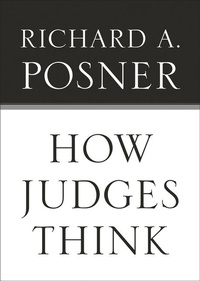
How Judges Think
Published on 1. May 2010
Book
Paperback/Softback
400 pages
978-0-674-04806-5 (ISBN)
Description
A distinguished and experienced appellate court judge, Richard A. Posner offers in this new book a unique and, to orthodox legal thinkers, a startling perspective on how judges and justices decide cases. When conventional legal materials enable judges to ascertain the true facts of a case and apply clear pre-existing legal rules to them, Posner argues, they do so straightforwardly; that is the domain of legalist reasoning. However, in non-routine cases, the conventional materials run out and judges are on their own, navigating uncharted seas with equipment consisting of experience, emotions, and often unconscious beliefs. In doing so, they take on a legislative role, though one that is confined by internal and external constraints, such as professional ethics, opinions of respected colleagues, and limitations imposed by other branches of government on freewheeling judicial discretion. Occasional legislators, judges are motivated by political considerations in a broad and sometimes a narrow sense of that term. In that open area, most American judges are legal pragmatists. Legal pragmatism is forward-looking and policy-based. It focuses on the consequences of a decision in both the short and the long term, rather than on its antecedent logic. Legal pragmatism so understood is really just a form of ordinary practical reasoning, rather than some special kind of legal reasoning.
Supreme Court justices are uniquely free from the constraints on ordinary judges and uniquely tempted to engage in legislative forms of adjudication. More than any other court, the Supreme Court is best understood as a political court.
Supreme Court justices are uniquely free from the constraints on ordinary judges and uniquely tempted to engage in legislative forms of adjudication. More than any other court, the Supreme Court is best understood as a political court.
Reviews / Votes
Posner is unique in the world of American jurisprudence, a highly regarded U.S. appellate judge and a prolific and controversial writer on legal philosophy. Opinionated, sarcastic and argumentative as ever, Posner is happy to weigh in not only on how judges think, but how he thinks they should think. When sticking to explaining the nine intellectual approaches to judging that he identifies, and to the gap between legal academics and judges, and his well-formulated pragmatic approach to judging, Posner is insightful, accessible, often funny and a model of clarity. * Publishers Weekly * Posner's latest book, How Judges Think, is important, if only because it's Posner looking at his own profession from the inside. Two of the chapters, "Judges Are Not Law Professors" and "Is Pragmatic Adjudication Inescapable?," are worth the price of admission by themselves. The book can be read as one long screed against the jurisprudence of Supreme Court Justice Antonin Scalia, and stands as a refutation to those who believe the category of conservative can lazily be applied to a mind as independent as Posner's. -- Barry Gewen * New York Times online * A prolific and brilliant writer, Posner's How Judges Think is perhaps his most illuminating work for its profound, and sometimes polemical, insights into the judicial process...Judge Posner's examination of the issues is thorough, scholarly and riveting. He has written an important book--a must read not just for lawyers, but also for anyone who wants to understand how the inscrutable, and sometimes oracular, process of judging really works. -- James D. Zirin * Forbes.com *More details
Language
English
Place of publication
Cambridge, Mass
United States
Target group
College/higher education
Professional and scholarly
Illustrations
1 line illustration, 8 tables
Dimensions
Height: 235 mm
Width: 156 mm
Thickness: 29 mm
Weight
462 gr
ISBN-13
978-0-674-04806-5 (9780674048065)
Copyright in bibliographic data and cover images is held by Nielsen Book Services Limited or by the publishers or by their respective licensors: all rights reserved.
Schweitzer Classification
Other editions
Additional editions
Richard A. Posner
How Judges Think
E-Book
05/2010
1st Edition
Harvard University Press
€23.79
Available for download
Previous edition

Richard A. Posner
How Judges Think
Book
04/2008
Harvard University Press
€48.42
Article exhausted; check for reprint
Person
Richard A. Posner retired as a judge of the United States Court of Appeals for the Seventh Circuit in 2017. He was previously a senior lecturer at the University of Chicago Law School.
Content
* Introduction Part One: The Basic Model * Nine Theories of Judicial Behavior * The Judge as Labor-Market Participant * The Judge as Occasional Legislator * The Mind of the Legislating Judge Part Two: The Model Elaborated * The Judicial Environment: External Constraints on Judging * Altering the Environment: Tenure and Salary Issues * Judicial Method: Internal Constraints on Judging * Judges Are Not Law Professors * Is Pragmatic Adjudication Inescapable? Part Three: Justices * The Supreme Court Is a Political Court * Comprehensive Constitutional Theories * Judicial Cosmopolitanism * Conclusion * Acknowledgments * Index