

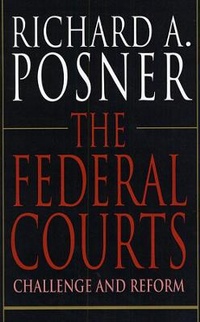
The Federal Courts
Challenge and Reform, Revised Edition
2nd Edition
Published on 15. September 1999
Book
Paperback/Softback
430 pages
978-0-674-29627-5 (ISBN)
Description
The federal courts are the world's most powerful judiciary and a vital element of the American political system. In recent decades, these courts have experienced unprecedented growth in caseload and personnel. Many judges and lawyers believe that a "crisis in quantity" is imperiling the ability of the federal judiciary to perform its historic function of administering justice fairly and expeditiously.
In a substantially revised edition of his widely acclaimed 1985 book The Federal Courts: Crisis and Reform, Chief Judge Richard A. Posner of the U.S. Court of Appeals for the Seventh Circuit provides a comprehensive evaluation of the federal judiciary and a detailed program of judicial reform. Drawing on economic and political theory as well as on legal analysis and his own extensive judicial experience, Posner sketches the history of the federal courts, describes the contemporary institution, appraises the concerns that have been expressed with the courts' performance, and presents a variety of proposals for both short-term and fundamental reform. In contrast to some of the direr prophecies of observers of the federal courts, Posner emphasizes the success of these courts in adapting to steep caseload growth with minimum sacrifice in quality.
Although the book ranges over a variety of traditional topics in federal jurisdiction, the focus is steady on federal judicial administration conceived of as an interdisciplinary approach emphasizing system rather than doctrine, statistics rather than impressions, and caseload rather than cases. Like the earlier edition, this book promises to be a landmark in the empirical study of judicial administration.
In a substantially revised edition of his widely acclaimed 1985 book The Federal Courts: Crisis and Reform, Chief Judge Richard A. Posner of the U.S. Court of Appeals for the Seventh Circuit provides a comprehensive evaluation of the federal judiciary and a detailed program of judicial reform. Drawing on economic and political theory as well as on legal analysis and his own extensive judicial experience, Posner sketches the history of the federal courts, describes the contemporary institution, appraises the concerns that have been expressed with the courts' performance, and presents a variety of proposals for both short-term and fundamental reform. In contrast to some of the direr prophecies of observers of the federal courts, Posner emphasizes the success of these courts in adapting to steep caseload growth with minimum sacrifice in quality.
Although the book ranges over a variety of traditional topics in federal jurisdiction, the focus is steady on federal judicial administration conceived of as an interdisciplinary approach emphasizing system rather than doctrine, statistics rather than impressions, and caseload rather than cases. Like the earlier edition, this book promises to be a landmark in the empirical study of judicial administration.
Reviews / Votes
In a revised and substantially improved edition of his classic 1985 book, The Federal Courts: Crisis and Reform, Posner, chief judge of the U.S. Court of Appeals for the Seventh Circuit, provides an insightful and distinctive examination of the problems and challenges that have arisen from the unprecedented growth in caseload in federal courts...[His] thoughtful analysis is highly recommended. * Library Journal * [T]he book provides a comprehensive evaluation of the federal judiciary. While Posner raises serious concerns about the burgeoning caseload in federal appellate courts, he also carefully distinguishes the caseload from the workload...Posner's thought-provoking proposals are worth consideration. Anyone concerned with the judicial administration of appellate courts should read this book. -- Mary Massaron Ross * State Bar of Michigan Appellate Practice Section Newsletter *More details
Edition
2nd Revised edition
Language
English
Place of publication
Cambridge, Mass
United States
Target group
Professional and scholarly
Edition type
Revised edition
Illustrations
8 line illustrations
Dimensions
Height: 235 mm
Width: 156 mm
Weight
581 gr
ISBN-13
978-0-674-29627-5 (9780674296275)
Copyright in bibliographic data and cover images is held by Nielsen Book Services Limited or by the publishers or by their respective licensors: all rights reserved.
Schweitzer Classification
Other editions
Additional editions
E-Book
07/2009
Harvard University Press
€40.39
Available for download
Person
Richard A. Posner retired as a judge of the United States Court of Appeals for the Seventh Circuit in 2017. He was previously a senior lecturer at the University of Chicago Law School.
Content
Preface The Institution The Organization of the Federal Courts The basic structure. The judges. The state courts compared. The Jurisdiction of the Federal Courts The Challenge The Growth of the Caseload Caseload ... versus workload. Caseload and workload in the Supreme Court. The Chicken Little question. Why the Caseload Has Grown So Models of caseload growth. The district courts. The courts of appeals. The Supreme Court. Consequences: The System Expands ... More judges, working harder. The rise of the law clerk. ...And Is Streamlined Curtailment of oral argument. Nonpublication of opinions. The standard of review, the trend toward "ruledness," summariness. Sanctions. Incremental Reform Palliatives Upping the ante. Limiting or abolishing diversity jurisdiction. Better management. Alternative dispute resolution. The reform of the bar. Specialized Courts Specialized Article III courts. Rethinking administrative review. Fundamental Reform The Role of Federal Courts in a Federal System The optimal scope of federal jurisdiction. Specific caseload implications. Federal Judicial Self-Restraint Principled adjudication. The meaning and consequences of judicial activism and self-restraint. The restraint ratchet and other extensions. The Federal Judicial Craft District judges. The institutional responsibilities of federal appellate judges. Rule versus standard again. Stare decisis. Appendix: Supplementary Tables Index