

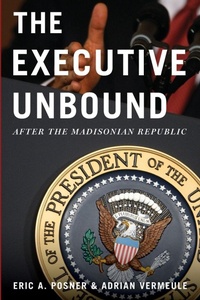
The Executive Unbound
After the Madisonian Republic
Published on 14. March 2013
Book
Paperback/Softback
256 pages
978-0-19-993403-4 (ISBN)
Description
Ever since Arthur M. Schlesinger Jr. used "imperial presidency" as a book title, the term has become central to the debate about the balance of power in the U.S. government. Since the presidency of George W. Bush, when advocates of executive power such as Dick Cheney gained ascendancy, the argument has blazed hotter than ever. Many argue the Constitution itself is in grave danger. What is to be done?
The answer, according to legal scholars Eric Posner and Adrian Vermeule, is nothing. In The Executive Unbound, they provide a bracing challenge to conventional wisdom, arguing that a strong presidency is inevitable in the modern world. Most scholars, they note, object to today's level of executive power because it varies so dramatically from the vision of the framers of the Constitution. But Posner and Vermeule find fault with James Madison's premises. Like an ideal market, they write, Madison's separation of powers has no central director, but it lacks the price system which gives an economy its structure; there is nothing in checks and balances that intrinsically generates order or promotes positive arrangements. In fact, the greater complexity of the modern world produces a concentration of power, particularly in the White House. The authors chart the rise of executive authority, noting that among strong presidents only Nixon has come in for severe criticism, leading to legislation which was designed to limit the presidency, yet which failed to do so. Political, cultural and social restraints, they argue, have been more effective in preventing dictatorship than any law. The executive-centered state tends to generate political checks that substitute for the legal checks of the Madisonian constitution.
Piety toward the founders and a historic fear of tyranny have been powerful forces in American political thinking. Posner and Vermeule confront them both in this startlingly original contribution.
The answer, according to legal scholars Eric Posner and Adrian Vermeule, is nothing. In The Executive Unbound, they provide a bracing challenge to conventional wisdom, arguing that a strong presidency is inevitable in the modern world. Most scholars, they note, object to today's level of executive power because it varies so dramatically from the vision of the framers of the Constitution. But Posner and Vermeule find fault with James Madison's premises. Like an ideal market, they write, Madison's separation of powers has no central director, but it lacks the price system which gives an economy its structure; there is nothing in checks and balances that intrinsically generates order or promotes positive arrangements. In fact, the greater complexity of the modern world produces a concentration of power, particularly in the White House. The authors chart the rise of executive authority, noting that among strong presidents only Nixon has come in for severe criticism, leading to legislation which was designed to limit the presidency, yet which failed to do so. Political, cultural and social restraints, they argue, have been more effective in preventing dictatorship than any law. The executive-centered state tends to generate political checks that substitute for the legal checks of the Madisonian constitution.
Piety toward the founders and a historic fear of tyranny have been powerful forces in American political thinking. Posner and Vermeule confront them both in this startlingly original contribution.
Reviews / Votes
A refreshingly straightforward case that the modern presidency is unconstrained by law--and that you should like it that way. Even those who...disagree vehemently with the latter proposition will find Posner and Vermuele's arguments provocative and challenging. * American Conservative * Powerfully argued, this book is an important part of the debate over presidential power in the present world. * Choice * Provocative. * American Prospect.org * A thought-provoking book. * Library Journal * This is a book that will, for many readers, both illuminate and infuriate. It is the most full-throated embrace in recent years of the very important (and always controversial) jurisprudential theories associated with Carl Schmitt, particularly with regard to the accretion of power in the Executive Branch. If their views become widely accepted, American law--or at least the American legal academy--will never be the same again. * Sanford Levinson, author of Our Undemocratic Constitution *More details
Language
English
Place of publication
New York
United States
Target group
College/higher education
Professional and scholarly
Dimensions
Height: 234 mm
Width: 156 mm
Thickness: 15 mm
Weight
442 gr
ISBN-13
978-0-19-993403-4 (9780199934034)
Copyright in bibliographic data and cover images is held by Nielsen Book Services Limited or by the publishers or by their respective licensors: all rights reserved.
Schweitzer Classification
Other editions
Additional editions
Book
06/2011
1st Edition
Oxford University Press Inc
€82.30
Shipment within 15-20 days
E-Book
03/2011
1st Edition
OUP eBook
€18.99
Available for download
E-Book
03/2011
1st Edition
OUP eBook
€18.99
Available for download
Persons
Eric A. Posner is Kirkland and Ellis Professor of Law at the University of Chicago Law School, and is the author of The Perils of Global Legalism, Terror in the Balance (written with Vermeule), and Climate Change Justice, among other books.
Adrian Vermeule is John H. Watson Jr. Professor of Law at Harvard Law School, and is the author of Law and the Limits of Reason, Mechanisms of Democracy, and Judging Under Uncertainty, and is the co-author with Posner of Terror in the Balance.
Adrian Vermeule is John H. Watson Jr. Professor of Law at Harvard Law School, and is the author of Law and the Limits of Reason, Mechanisms of Democracy, and Judging Under Uncertainty, and is the co-author with Posner of Terror in the Balance.
Content
Introduction ; 1. The Constitutional Framework ; 2. Constitutional Change ; 3. The Statutory Framework ; 4. Constraints on the Executive ; 5. Global Liberal Legalism ; 6. Tyrannophobia ; Conclusion