

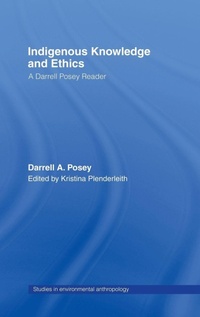
Indigenous Knowledge and Ethics
A Darrell Posey Reader
Published on 1. April 2004
Book
Hardback
292 pages
978-0-415-32363-5 (ISBN)
Description
Darrell A. Posey, who died in 2001, was internationally known for his support of indigenous peoples and their natural habitats, and particularly for his pioneering work with the Kayapo people of Brazil. He was an organiser of the First International Congress of Ethnobiology which resulted in the Declaration of Belem: the first instance of an international scientific organisation recognizing an obligation to compensate native peoples for use of their knowledge and biological resources. In 1993, Posey received the United Nations Global 500 Award for Outstanding Achievement in Service to the Environment. Indigenous Knowledge and Ethics presents seventeen of his articles on the topics of environment, indigenous knowledge and intellectual property rights. Demonstrating his belief in the validity of indigenous knowledge systems, and his insistence that indigenous rights must be recognised and protected, it is an ideal introduction to his thought and work.
More details
Series
Language
English
Place of publication
London
United Kingdom
Publishing group
Taylor & Francis Ltd
Target group
College/higher education
Postgraduate
Dimensions
Height: 240 mm
Width: 161 mm
Thickness: 20 mm
Weight
605 gr
ISBN-13
978-0-415-32363-5 (9780415323635)
Copyright in bibliographic data and cover images is held by Nielsen Book Services Limited or by the publishers or by their respective licensors: all rights reserved.
Schweitzer Classification
Other editions
Additional editions
Book
11/2011
1st Edition
Routledge
€83.90
Shipment within 15-20 days
Persons
Darrell A. Posey, who died in 2001, was internationally known for his advocacy of indigenous peoples: from his pioneering association with the Kayapo of Brazil to his global campaign to protect indigenous knowledge and practices using the concept of Traditional Resource Rights. Edited by Kristiana Plenderleith.
Content
1 Introduction to ethnobiology: its implications and applications PART I Ethnoentomology 2 Topics and issues in ethnoentomology with some suggestions for the development of hypothesis-generation and testing in ethnobiology 3 Ethnoentomological survey of Brazilian Indians 4 Entomological considerations in south-eastern aboriginal demography 5 An ethnoentomological perspective of the south-eastern Indian belief system PART II Wider applications of indigenous knowledge 6 The application of ethnobiology in the conservation of dwindling natural resources: lost knowledge or options for the survival of the planet 7 Ethnobiology and ethnodevelopment: importance of traditional knowledge and traditional peoples 8 Ethnoecology as applied anthropology in Amazonian development 9 The perception of ecological zones and natural resources in the Brazilian Amazon: an ethnoecology of Lake Coari 10 Diachronic ecotones and anthropogenic landscapes in Amazonia: contesting the consciousness of conservation 11 Indigenous knowledge, biodiversity, and international rights: learning about forests from the Kayapo Indians of the Brazilian Amazon PART III Intellectual property rights and ethical concerns 12 Intellectual property rights: what is the position of ethnobiology? 13 Indigenous knowledge and green consumerism: co-operation or conflict? 14 Traditional Resource Rights (TRR): de facto self-determination for indigenous peoples 15 Finders keepers won't do any more: Darrell Posey says the time has come for a rethink on bioprospecting 16 Indigenous peoples and Traditional Resource Rights:a basis for equitable relationships? 17 The 'balance sheet' and the 'sacred balance': valuing the knowledge of indigenous and traditional peoples