

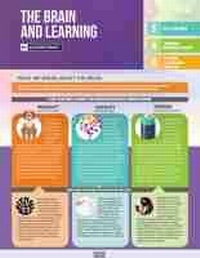
The Brain and Learning
Quick Reference Guide
Will be published approx. on 12. June 2019
Book
Fold-out book or chart
6 pages
978-1-4166-2813-2 (ISBN)
Description
In this quick reference guide Allison Posey, author of Engage the Brain: How to Design for Learning That Taps into the Power of Emotion, relates what we currently know about the brain to our pedagogy. She explores
- 3 overarching facts about the brain that can influence instruction design.
- 3 important brain functions for learning: perception and attention, emotion, and memory.
- 4 common misconceptions about the brain.
- 8 tips for classroom practice. This guide's practical tips and ideas will help teachers get started right away in designing different learning pathways for their students.8.5"" x 11"" 3-panel foldout guide (6 pages), laminated for extra durability and 3-hole-punched for binder storage.
- 3 overarching facts about the brain that can influence instruction design.
- 3 important brain functions for learning: perception and attention, emotion, and memory.
- 4 common misconceptions about the brain.
- 8 tips for classroom practice. This guide's practical tips and ideas will help teachers get started right away in designing different learning pathways for their students.8.5"" x 11"" 3-panel foldout guide (6 pages), laminated for extra durability and 3-hole-punched for binder storage.
More details
Language
English
Place of publication
Alexandria
United States
Target group
Professional and scholarly
Dimensions
Height: 279 mm
Width: 216 mm
ISBN-13
978-1-4166-2813-2 (9781416628132)
Copyright in bibliographic data and cover images is held by Nielsen Book Services Limited or by the publishers or by their respective licensors: all rights reserved.
Schweitzer Classification
Person
Allison Posey is a curriculum and design specialist at CAST, the Center for Applied Special Technology. There, she engages in curricular design, leads professional development trainings for the Universal Design for Learning framework, and supports online course instruction, including the UDL Affect and Engagement course. She works with educators across the United States and internationally to integrate and apply current understandings from brain research about learning into instructional practices so that all learners can engage in rigorous learning opportunities. She coordinates the CAST free webinar series and presents on the central role of emotions in learning.