

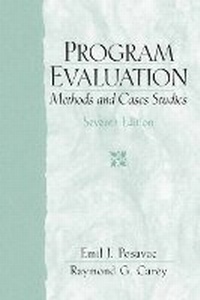
Program Evaluation
Methods and Case Studies
7th Edition
Published on 27. July 2006
Book
Hardback
320 pages
978-0-13-227560-6 (ISBN)
Description
For upper-level undergraduate/ graduate-level courses in Program Evaluation, Program Planning, Program Administration, and Public Administration.
Comprehensive yet accessible, this text provides a practical introduction to the skills, attitudes, and methods required to assess the worth and value of human services offered in public and private organizations in a wide range of fields. Students are introduced to the need for such activities, the methods for carrying out evaluations, and the essential steps in organizing findings into reports. The text focuses on the work of people who are closely associated with the service to be evaluated, and is designed to help program planners, developers, and evaluators to work with program staff members who might be threatened by program evaluation.
Comprehensive yet accessible, this text provides a practical introduction to the skills, attitudes, and methods required to assess the worth and value of human services offered in public and private organizations in a wide range of fields. Students are introduced to the need for such activities, the methods for carrying out evaluations, and the essential steps in organizing findings into reports. The text focuses on the work of people who are closely associated with the service to be evaluated, and is designed to help program planners, developers, and evaluators to work with program staff members who might be threatened by program evaluation.
More details
Edition
7th edition
Language
English
Place of publication
New York
United States
Publishing group
Taylor & Francis Inc
Target group
Professional and scholarly
Dimensions
Height: 161 mm
Width: 230 mm
Thickness: 23 mm
Weight
572 gr
ISBN-13
978-0-13-227560-6 (9780132275606)
Copyright in bibliographic data and cover images is held by Nielsen Book Services Limited or by the publishers or by their respective licensors: all rights reserved.
Schweitzer Classification
Other editions
New editions

Book
07/2015
8th Edition
Pearson
€200.56
Article not available for order
Previous edition
Book
06/2002
6th Edition
Routledge
Unfortunately, price unknown
No shipping information available
Content
** Each chapter contains a Summary & Preview, Study Questions and Additional Resources
Ch. 1. Program Evaluation: An Overview
Ch. 2. Planning an Evaluation
Ch. 3. Selecting Criteria and Setting Standards
Ch. 4. Developing Measures
Ch. 5. Ethics in Program Evaluation
Ch. 6. The assessment of Need
Ch. 7. Monitoring the Operation of Programs
Ch. 8. Qualitative Evaluation Methods
Ch. 9. Single-Group, Non-experimental Outcome
Ch. 10. Quasi-Experimental Approaches
Ch. 11. Using Experiments to Evaluate Programs
Ch. 12. Analyses of Costs and Outcomes
Ch. 13. Evaluation Reports: Interpreting and Communicating Findings
Ch. 14. How to Encourage Utilization
7 CASE STUDIES THROUGHOUT TEXT
Case Study 1: Using Multiple Measures in and Evaluation of a Summer Community Program for Youth (ch. 4)
Case Study 2: Using Qualitative methods in and Evaluation of a University Library (ch. 8)
Case Study 3: A Pretest-Posttest Design to Evaluate a Peer-Based Program to Prevent Skin Cancer (ch. 9)
Case Study 4: Nonequivalent Control Groups used to Evaluate and Employee Incentive Plan (ch. 10)
Case Study 5: Teaching Doctors Communication Skills: an evaluation with Random Assignment and Pretests (ch. 11)
Case Study 6: The Value of Providing Smoking Cessation Clinics for Employees on Company Time (ch. 12)
Case Study 7: Evaluations of the Outcomes of Boot Camp Prisons: The Value of Finding No Differences Between Program and Comparison Groups (ch. 14)
Ch. 1. Program Evaluation: An Overview
Ch. 2. Planning an Evaluation
Ch. 3. Selecting Criteria and Setting Standards
Ch. 4. Developing Measures
Ch. 5. Ethics in Program Evaluation
Ch. 6. The assessment of Need
Ch. 7. Monitoring the Operation of Programs
Ch. 8. Qualitative Evaluation Methods
Ch. 9. Single-Group, Non-experimental Outcome
Ch. 10. Quasi-Experimental Approaches
Ch. 11. Using Experiments to Evaluate Programs
Ch. 12. Analyses of Costs and Outcomes
Ch. 13. Evaluation Reports: Interpreting and Communicating Findings
Ch. 14. How to Encourage Utilization
7 CASE STUDIES THROUGHOUT TEXT
Case Study 1: Using Multiple Measures in and Evaluation of a Summer Community Program for Youth (ch. 4)
Case Study 2: Using Qualitative methods in and Evaluation of a University Library (ch. 8)
Case Study 3: A Pretest-Posttest Design to Evaluate a Peer-Based Program to Prevent Skin Cancer (ch. 9)
Case Study 4: Nonequivalent Control Groups used to Evaluate and Employee Incentive Plan (ch. 10)
Case Study 5: Teaching Doctors Communication Skills: an evaluation with Random Assignment and Pretests (ch. 11)
Case Study 6: The Value of Providing Smoking Cessation Clinics for Employees on Company Time (ch. 12)
Case Study 7: Evaluations of the Outcomes of Boot Camp Prisons: The Value of Finding No Differences Between Program and Comparison Groups (ch. 14)