

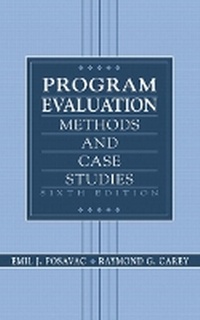
Program Evaluation
Methods and Case Studies
6th Edition
Published on 25. June 2002
Book
Hardback
344 pages
978-0-13-040966-9 (ISBN)
Description
For upper-level undergraduate/ graduate-level courses in Program Evaluation, Program Planning, Program Administration, and Public Administration, in departments of Psychology, Sociology, Criminal Justice, Corrections, Public Health, Public Administration, Political Science, Human Services, Community Nursing, Educational Administration, Higher Education, Substance Abuse Program Administration, and Social Work.
Comprehensive yet accessible, this text provides a practical introduction to the skills, attitudes, and methods required to assess the worth and value of human services offered in public and private organizations in a wide range of fields. Students are introduced to the need for such activities, the methods for carrying out evaluations, and the essential steps in organizing findings into reports. The text focuses on the work of people who are closely associated with the service to be evaluated, and is designed to help program planners, developers, and evaluators to work with program staff members who might be threatened by program evaluation.
Comprehensive yet accessible, this text provides a practical introduction to the skills, attitudes, and methods required to assess the worth and value of human services offered in public and private organizations in a wide range of fields. Students are introduced to the need for such activities, the methods for carrying out evaluations, and the essential steps in organizing findings into reports. The text focuses on the work of people who are closely associated with the service to be evaluated, and is designed to help program planners, developers, and evaluators to work with program staff members who might be threatened by program evaluation.
More details
Edition
6th edition
Language
English
Place of publication
New York
United States
Publishing group
Taylor & Francis Inc
Target group
Professional and scholarly
Dimensions
Height: 160 mm
Width: 236 mm
Thickness: 22 mm
Weight
611 gr
ISBN-13
978-0-13-040966-9 (9780130409669)
Copyright in bibliographic data and cover images is held by Nielsen Book Services Limited or by the publishers or by their respective licensors: all rights reserved.
Schweitzer Classification
Other editions
New editions
Book
07/2006
7th Edition
Routledge
Unfortunately, price unknown
No shipping information available
Previous edition

Book
10/1996
5th Edition
Routledge
Unfortunately, price unknown
No shipping information available
Persons
Emil J. Posavac (Ph.D., University of Illinois, Champaign) is professor of Psychology at Loyola University of Chicago where he has served as director of the Applied Social Psychology Program and chairman of the Psychology Department. He has consulted with a number of public and private organizations. He has published sixty papers and chapters, edited or co-edited six volumes on program evaluation and applied social psychology, and written numerous evaluation reports for health care and educational institutions. He is currently completing a textbook (with Eugene B. Zechmeister) on statistical analysis based on emerging orientations that emphasize a more complete understanding and presentation of data. He is a member of the American Psychological Society, the Society for the Advancement of Social Psychology, and the American Evaluation Association, among other groups. In 1990, he was awarded the Myrdal Award by the American Evaluation Association for his contributions to the advancement of program evaluation practice.
Raymond G. Carey (Ph.D., Loyola University of Chicago) is principal of R. G. Carey Associates. He was the vice president of Parkside Associates, Inc., a member of the Lutheran General Health Care System (now Advocate Health Care). Widely published in the fields of health services and quality assurance, Dr. Carey has consulted on employee attitudes and quality assurance to hospitals throughout the U.S. In addition, he was a member of the Technical Advisory Panel of the Post-Acute Care Study for the U.S. Department of Health and Human Services. He teaches quality improvement procedures for hospital managers seeking to improve the quality of their health services. Carey is the author of Managing to Win: Evaluating the Use of Human Resources in Health Care Organizations and Measuring Quality Improvement in Healthcare: A Guide to Statistical Process Control Applications (with Robert C. Lloyd).
Raymond G. Carey (Ph.D., Loyola University of Chicago) is principal of R. G. Carey Associates. He was the vice president of Parkside Associates, Inc., a member of the Lutheran General Health Care System (now Advocate Health Care). Widely published in the fields of health services and quality assurance, Dr. Carey has consulted on employee attitudes and quality assurance to hospitals throughout the U.S. In addition, he was a member of the Technical Advisory Panel of the Post-Acute Care Study for the U.S. Department of Health and Human Services. He teaches quality improvement procedures for hospital managers seeking to improve the quality of their health services. Carey is the author of Managing to Win: Evaluating the Use of Human Resources in Health Care Organizations and Measuring Quality Improvement in Healthcare: A Guide to Statistical Process Control Applications (with Robert C. Lloyd).
Content
1. Program Evaluation: An Overview.
2. Planning an Evaluation.
3. Selecting Criteria and Setting Standards.
4. Developing Measures.
5. Ethics in Program Evaluation.
6. The Assessment of Need.
7. Monitoring the Operation of Programs.
8. Single-Group, Nonexperimental Outcome Evaluations.
9. Quasi-Experimental Approaches to Outcome Evaluation.
10. Using Experiments to Evaluate Programs.
11. Analysis of Costs and Outcomes.
12. Qualitative Evaluation Methods.
13. Evaluation Reports: Interpreting and Communicating Findings.
14. How to Encourage Utilization.
Appendix: Illustrative Evaluation Report.
References.
Name Index.
Subject Index.
2. Planning an Evaluation.
3. Selecting Criteria and Setting Standards.
4. Developing Measures.
5. Ethics in Program Evaluation.
6. The Assessment of Need.
7. Monitoring the Operation of Programs.
8. Single-Group, Nonexperimental Outcome Evaluations.
9. Quasi-Experimental Approaches to Outcome Evaluation.
10. Using Experiments to Evaluate Programs.
11. Analysis of Costs and Outcomes.
12. Qualitative Evaluation Methods.
13. Evaluation Reports: Interpreting and Communicating Findings.
14. How to Encourage Utilization.
Appendix: Illustrative Evaluation Report.
References.
Name Index.
Subject Index.