

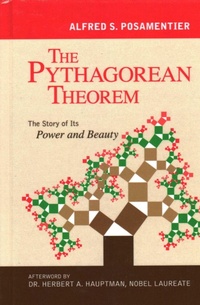
The Pythagorean Theorem
The Story of Its Power and Beauty
Published on 22. August 2010
Book
Hardback
320 pages
978-1-61614-181-3 (ISBN)
Description
The Pythagorean theorem may be the best-known equation in mathematics. Its origins reach back to the beginnings of civilization, and today every student continues to study it. What most nonmathematicians don't understand or appreciate is why this simply stated theorem has fascinated countless generations. In this entertaining and informative book, a veteran math educator makes the importance of the Pythagorean theorem delightfully clear.
He begins with a brief history of Pythagoras and the early use of his theorem by the ancient Egyptians, Babylonians, Indians, and Chinese, who used it intuitively long before Pythagoras's name was attached to it. He then shows the many ingenious ways in which the theorem has been proved visually using highly imaginative diagrams. Some of these go back to ancient mathematicians; others are comparatively recent proofs, including one by the twentieth president of the United States, James A. Garfield.
After demonstrating some curious applications of the theorem, the author then explores the Pythagorean triples, pointing out the many hidden surprises of the three numbers that can represent the sides of the right triangle (e.g, 3, 4, 5 and 5, 12, 13). And many will truly amaze the reader. He then turns to the "Pythagorean means" (the arithmetic, geometric, and harmonic means). By comparing their magnitudes in a variety of ways, he gives the reader a true appreciation for these mathematical concepts.
The final two chapters view the Pythagorean theorem from an artistic point of view - namely, how Pythagoras's work manifests itself in music and how the Pythagorean theorem can influence fractals.
The author's lucid presentation and gift for conveying the significance of this key equation to those with little math background will inform, entertain, and inspire the reader, once again demonstrating the power and beauty of mathematics!
He begins with a brief history of Pythagoras and the early use of his theorem by the ancient Egyptians, Babylonians, Indians, and Chinese, who used it intuitively long before Pythagoras's name was attached to it. He then shows the many ingenious ways in which the theorem has been proved visually using highly imaginative diagrams. Some of these go back to ancient mathematicians; others are comparatively recent proofs, including one by the twentieth president of the United States, James A. Garfield.
After demonstrating some curious applications of the theorem, the author then explores the Pythagorean triples, pointing out the many hidden surprises of the three numbers that can represent the sides of the right triangle (e.g, 3, 4, 5 and 5, 12, 13). And many will truly amaze the reader. He then turns to the "Pythagorean means" (the arithmetic, geometric, and harmonic means). By comparing their magnitudes in a variety of ways, he gives the reader a true appreciation for these mathematical concepts.
The final two chapters view the Pythagorean theorem from an artistic point of view - namely, how Pythagoras's work manifests itself in music and how the Pythagorean theorem can influence fractals.
The author's lucid presentation and gift for conveying the significance of this key equation to those with little math background will inform, entertain, and inspire the reader, once again demonstrating the power and beauty of mathematics!
More details
Language
English
Place of publication
United States
Product notice
sewn/stitched
Cloth over boards
With dust jacket
Dimensions
Height: 240 mm
Width: 164 mm
Thickness: 27 mm
Weight
582 gr
ISBN-13
978-1-61614-181-3 (9781616141813)
Copyright in bibliographic data and cover images is held by Nielsen Book Services Limited or by the publishers or by their respective licensors: all rights reserved.
Schweitzer Classification