

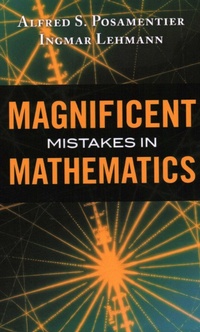
Magnificent Mistakes in Mathematics
Published on 13. August 2013
Book
Hardback
308 pages
978-1-61614-747-1 (ISBN)
Description
Two veteran math educators demonstrate how some "magnificent mistakes" had profound consequences for our understanding of mathematics' key concepts.
In the nineteenth century, English mathematician William Shanks spent fifteen years calculating the value of pi, setting a record for the number of decimal places. Later, his calculation was reproduced using large wooden numerals to decorate the cupola of a hall in the Palais de la Decouverte in Paris. However, in 1946, with the aid of a mechanical desk calculator that ran for seventy hours, it was discovered that there was a mistake in the 528th decimal place. Today, supercomputers have determined the value of pi to trillions of decimal places.
This is just one of the amusing and intriguing stories about mistakes in mathematics in this layperson's guide to mathematical principles. In another example, the authors show that when we "prove" that every triangle is isosceles, we are violating a concept not even known to Euclid - that of "betweenness." And if we disregard the time-honored Pythagorean theorem, this is a misuse of the concept of infinity. Even using correct procedures can sometimes lead to absurd - but enlightening - results.
Requiring no more than high-school-level math competency, this playful excursion through the nuances of math will give you a better grasp of this fundamental, all-important science.
In the nineteenth century, English mathematician William Shanks spent fifteen years calculating the value of pi, setting a record for the number of decimal places. Later, his calculation was reproduced using large wooden numerals to decorate the cupola of a hall in the Palais de la Decouverte in Paris. However, in 1946, with the aid of a mechanical desk calculator that ran for seventy hours, it was discovered that there was a mistake in the 528th decimal place. Today, supercomputers have determined the value of pi to trillions of decimal places.
This is just one of the amusing and intriguing stories about mistakes in mathematics in this layperson's guide to mathematical principles. In another example, the authors show that when we "prove" that every triangle is isosceles, we are violating a concept not even known to Euclid - that of "betweenness." And if we disregard the time-honored Pythagorean theorem, this is a misuse of the concept of infinity. Even using correct procedures can sometimes lead to absurd - but enlightening - results.
Requiring no more than high-school-level math competency, this playful excursion through the nuances of math will give you a better grasp of this fundamental, all-important science.
More details
Language
English
Place of publication
United States
Product notice
sewn/stitched
Cloth over boards
Dimensions
Height: 236 mm
Width: 156 mm
Thickness: 27 mm
Weight
554 gr
ISBN-13
978-1-61614-747-1 (9781616147471)
Copyright in bibliographic data and cover images is held by Nielsen Book Services Limited or by the publishers or by their respective licensors: all rights reserved.
Schweitzer Classification
Other editions
Additional editions
Alfred S. Posamentier | Ingmar Lehmann
Magnificent Mistakes in Mathematics
E-Book
08/2013
Prometheus Books
€15.81
Available for download
Persons
Alfred S. Posamentier is dean of the School of Education and professor of mathematics education at Mercy College in Dobbs Ferry, New York. Previously, he had the same positions at the City College of the City University of New York for forty years. He has published over fifty-five books in the area of mathematics and mathematics education, including The Fabulous Fibonacci Numbers (with Ingmar Lehmann). b>Ingmar Lehmann is retired from the mathematics faculty at Humboldt University in Berlin. For many years he led the Berlin Mathematics Student Society for gifted secondary-school students, with which he is still closely engaged today. He is the coauthor with Alfred S. Posamentier of The Secrets of Triangles, The Glorious Golden Ratio, and three other books.