

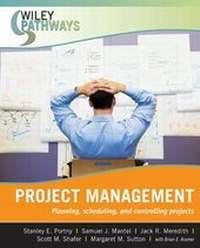
Wiley Pathways Project Management
Published on 20. April 2007
Book
Paperback/Softback
484 pages
978-0-470-11124-6 (ISBN)
Unfortunately, price unknown
Article is exhausted; no reprint
Description
This new text provides students with clear step-by-step techniques for creating, developing, and evaluating essential project management tools. Readers will learn concepts and skills using project plans, work breakdown structures, budgets, network diagrams, resource allocations, and project evaluations.
More details
Edition
1. Auflage
Language
English
Place of publication
Chichester
United Kingdom
Publishing group
John Wiley and Sons Ltd
Target group
Professional and scholarly
Dimensions
Height: 23.2 cm
Width: 18.8 cm
Thickness: 2.6 cm
Weight
810 gr
ISBN-13
978-0-470-11124-6 (9780470111246)
Schweitzer Classification
Persons
Stanley Portny, PMP, president of Stanley E. Portny and Associates, LLC, is an internationally recognized expert in project management and project leadership. During the past 28 years, he has provided training and consultation to more than 100 public and private organizations in the fields of finance, consumer products, insurance, telecommunications, pharmaceuticals, information technology, defense, and health care. He has developed and conducted training programs for over 25,000 management and staff personnel in engineering, sales and marketing, research and development, information systems, manufacturing, operations, and support areas.
Content
Chapter 1: Defining Project Management Today
Chapter 2: The Project: Defining Needs and Identifying Solutions
Chapter 3: Project Organizations
Chapter 4: The Project Plan
Chapter 5: The Project Budget.
Chapter 6: Defining the Schedule
Chapter 7: Estimating and Allocating Resources
Chapter 8: Being an Effective Project Manager
Chapter 9: Involving the Right People in Your Project.
Chapter 10: Managing Project Teams
Chapter 11: Tracking Progress and Maintaining Control
Chapter 12: Communicating and Documenting Progress
Chapter 13: Managing Risk
Chapter 14: Evaluating and Ending the Project