

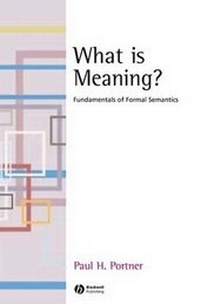
What is Meaning?
Fundamentals of Formal Semantics
Published on 10. December 2004
Book
Paperback/Softback
246 pages
978-1-4051-0918-5 (ISBN)
Description
What is Meaning? Fundamentals of Formal Semantics is a concise introduction to the field of semantics as it is actually practiced. Through simple examples, pictures, and metaphors, Paul Portner presents the field's key ideas about how language works.
* Explains the fundamental ideas and some of the most significant results of modern semantic theory
* Combines foundational discussion with simplified analyses of complex phenomena to provide readers with a sense of the fascination to be found in the details of the human language
* Includes exercises and thought-provoking questions to facilitate learning
Reviews / Votes
"An excellent book for advanced undergraduates and beginning graduate students. Portner's approachable, yet serious, presentation gives the reader a firm understanding of the breadth and depth of the science of natural language meaning." Kai von Fintel, Massachusetts Institute of TechnologyMore details
Series
Edition
1. Auflage
Language
English
Place of publication
Hoboken
United Kingdom
Publishing group
John Wiley and Sons Ltd
Target group
Professional and scholarly
undergraduate and graduate students studying semantics theory, as well as some general readers
Dimensions
Height: 22.7 cm
Width: 15.3 cm
Thickness: 1.4 cm
Weight
370 gr
ISBN-13
978-1-4051-0918-5 (9781405109185)
Schweitzer Classification
Other editions
Additional editions

Book
12/2004
1st Edition
Wiley
€120.03
Shipment within 3-4 weeks
Person
Paul H. Portner is Associate Professor of Linguistics and Director of the Interdisciplinary Program in Cognitive Science at Georgetown University. He is co-editor of Formal Semantics: The Essential Readings (with Barbara H. Partee, Blackwell, 2002) as well as the author of numerous articles on topics such as mood and modality, tense and aspect, and the syntax/semantics interface.
Content
1. The Fundamental Question.
2. Putting a meaning together from pieces.
3. More about predicates.
4. Modifiers.
5. Complexities of referring expressions.
6. Quantifiers.
7. Extensional vs. intensional contexts.
8. Tense, aspect, and modality.
9. Propositional attitudes.
10. The pragmatics of what's given.
11. The pragmatics of Inference.
12. Formal Semantics Today.
Appendix: Answers to selected exercises.
References.
Index