

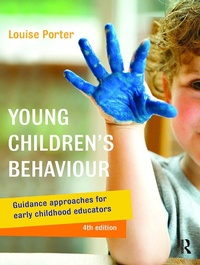
Young Children's Behaviour
Guidance approaches for early childhood educators
4th Edition
Published on 31. March 2021
Book
Hardback
504 pages
978-0-367-72019-3 (ISBN)
Description
'The book provides a comprehensive, yet practical discussion of guidance strategies that can be implemented in a variety of situations. These strategies promote a respect for children and their rights, enhance children's self-esteem, and help to foster pro-social skills. This book is a must-read for both students and practitioners who work with children and families.' - Dr Laura McFarland, School of Education, Charles Sturt University
Drawing on the latest research evidence, Young Children's Behaviour outlines the beliefs and values that underpin the guidance approach to managing the behaviours of children from birth to eight years of age. In contrast with rewards-and-punishment systems, guidance believes that children do not need incentives to behave well, but instead need skills. Rather than punishing them for lacking skills, guidance teaches young children self-regulation skills so that they can behave considerately.
The author provides practical strategies that both meet children's needs and safeguard the rights of surrounding adults and children. These methods include listening, being assertive, giving positive instructions, solving problems collaboratively, and coaching children to self-regulate their emotions and impulses. The text also offers advice on responding to many common challenges including separation distress, meltdowns, aggression, and social withdrawal. Finally, the book suggests how educators can provide educational and behavioural support for children with atypical development and describes how to foster effective relationships with parents whose children display challenging behaviours.
Dr Louise Porter powerfully argues that behaviour guidance is the most effective approach to working with young children and reflects the deepest values of early childhood education and care.
Drawing on the latest research evidence, Young Children's Behaviour outlines the beliefs and values that underpin the guidance approach to managing the behaviours of children from birth to eight years of age. In contrast with rewards-and-punishment systems, guidance believes that children do not need incentives to behave well, but instead need skills. Rather than punishing them for lacking skills, guidance teaches young children self-regulation skills so that they can behave considerately.
The author provides practical strategies that both meet children's needs and safeguard the rights of surrounding adults and children. These methods include listening, being assertive, giving positive instructions, solving problems collaboratively, and coaching children to self-regulate their emotions and impulses. The text also offers advice on responding to many common challenges including separation distress, meltdowns, aggression, and social withdrawal. Finally, the book suggests how educators can provide educational and behavioural support for children with atypical development and describes how to foster effective relationships with parents whose children display challenging behaviours.
Dr Louise Porter powerfully argues that behaviour guidance is the most effective approach to working with young children and reflects the deepest values of early childhood education and care.
More details
Edition
4th edition
Language
English
Place of publication
London
United Kingdom
Publishing group
Taylor & Francis Ltd
Target group
College/higher education
Edition type
New edition
Product notice
sewn/stitched
Cloth over boards
Dimensions
Height: 230 mm
Width: 176 mm
Weight
1090 gr
ISBN-13
978-0-367-72019-3 (9780367720193)
Copyright in bibliographic data and cover images is held by Nielsen Book Services Limited or by the publishers or by their respective licensors: all rights reserved.
Schweitzer Classification
Other editions
Additional editions
E-Book
07/2020
4th Edition
Routledge
€51.49
Available for download
E-Book
07/2020
4th Edition
Routledge
€51.49
Available for download
Book
01/2016
4th Edition
Allen & Unwin
€65.87
Shipment within 3-4 weeks
Person
An adjunct senior lecturer at Flinders University, Dr Louise Porter is a child psychologist with 35 years' experience of working with children. A sought-after international speaker, she is also the author of many books including A Comprehensive Guide to Classroom Management, Parental Guidance Recommended and Gifted Young Children.
Content
Introduction
1. Principles of early years education
2. Principles of behaviour guidance
3. Needs
4. Understanding emotions
5. Providing a child-centred program: mastery and accomplishment
6. Meeting children's basic needs: survival, safety and wellbeing
7. Meeting children's need for self-esteem: competence and worth
8. Meeting children's need to belong: care and connection
9. Meeting children's need for autonomy: voice and choice
10. Influences on behaviour
11. Listening to children
12. Everyday guidance practices
13. Supporting children's self-regulation
14. Solving persistent problems
15. Solutions to children's emotional difficulties
16. Solutions to children's social difficulties
17. Interventions for children with atypical development
18. Collaboration with parents
Resources
Notes
Bibliography
Index
1. Principles of early years education
2. Principles of behaviour guidance
3. Needs
4. Understanding emotions
5. Providing a child-centred program: mastery and accomplishment
6. Meeting children's basic needs: survival, safety and wellbeing
7. Meeting children's need for self-esteem: competence and worth
8. Meeting children's need to belong: care and connection
9. Meeting children's need for autonomy: voice and choice
10. Influences on behaviour
11. Listening to children
12. Everyday guidance practices
13. Supporting children's self-regulation
14. Solving persistent problems
15. Solutions to children's emotional difficulties
16. Solutions to children's social difficulties
17. Interventions for children with atypical development
18. Collaboration with parents
Resources
Notes
Bibliography
Index