

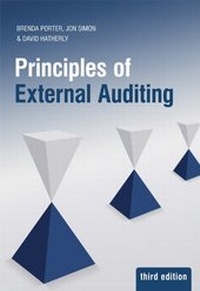
Principles of External Auditing
3rd Edition
Published on 15. August 2008
Book
Paperback/Softback
816 pages
978-0-470-01825-5 (ISBN)
Description
This book provides a comprehensive and exacting introduction to the principles and practice of external auditing. It describes and explains, in non-technical language, the nature of the audit function and the principles of the audit process.
The book covers international auditing and accounting standards and relevant statute and case law. It explains the fundamental concepts of auditing and takes the reader through the various stages of the audit process. It also discusses topical aspects of auditing such as legal liability, audit risk, quality control, and the impact of information technology.
The book covers international auditing and accounting standards and relevant statute and case law. It explains the fundamental concepts of auditing and takes the reader through the various stages of the audit process. It also discusses topical aspects of auditing such as legal liability, audit risk, quality control, and the impact of information technology.
More details
Edition
3., Auflage
Language
English
Place of publication
Chichester
United Kingdom
Publishing group
John Wiley and Sons Ltd
Target group
Professional and scholarly
Edition type
Revised edition
Illustrations
Illustrations
Dimensions
Height: 24.4 cm
Width: 16.8 cm
Thickness: 41 mm
Weight
1358 gr
ISBN-13
978-0-470-01825-5 (9780470018255)
Schweitzer Classification
Other editions
New editions
Brenda Porter | Jon Simon | David Hatherly
Principles of External Auditing
Book
02/2014
Wiley
€71.90
Shipment within 10-20 days
Content
Preface.
What is auditing?
The development of auditing and audit objectives.
A framework of auditing concepts.
Threats to, and preservation of, auditors' independence.
Legal and professional duties of auditors.
Overview of the audit process, audit evidence: staffing and documenting an audit.
Commencing an audit: engagement procedures and gaining an understanding of the client.
Planning the audit and assessing audit risk.
Internal controls and the auditor.
Testing the financial statement assertions: substantive testing.
Introduction to audit sampling and computer assisted auditing techniques (CAATs).
Completion and review.
Auditors' reports to users of financial statements and to management.
Legal liability of auditors.
Avoiding and limiting auditors' liability.
Internal audits.
Environmental audits.
Appendix: Summary of steps in a statutory financial statement audit.
Index.
What is auditing?
The development of auditing and audit objectives.
A framework of auditing concepts.
Threats to, and preservation of, auditors' independence.
Legal and professional duties of auditors.
Overview of the audit process, audit evidence: staffing and documenting an audit.
Commencing an audit: engagement procedures and gaining an understanding of the client.
Planning the audit and assessing audit risk.
Internal controls and the auditor.
Testing the financial statement assertions: substantive testing.
Introduction to audit sampling and computer assisted auditing techniques (CAATs).
Completion and review.
Auditors' reports to users of financial statements and to management.
Legal liability of auditors.
Avoiding and limiting auditors' liability.
Internal audits.
Environmental audits.
Appendix: Summary of steps in a statutory financial statement audit.
Index.