

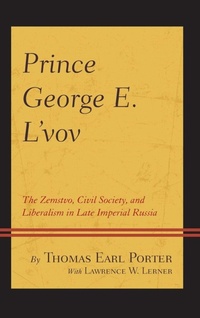
Prince George E. L'vov
The Zemstvo, Civil Society, and Liberalism in Late Imperial Russia
Published on 4. October 2017
Book
Hardback
276 pages
978-1-4985-1867-3 (ISBN)
Description
Prince George E. Lvov was born in Dresden in 1861, the same year Tsar Alexander II emancipated the serfs and Russia began to move away from its static society of orders toward a more modern polity. He died in exile in Paris in 1925 with Russia once again in thralldom. Prince L'vov dedicated his life to the improvement of the peasantry's condition and, like many other liberals, hoped to acculturate them to the norms and values of a civil society to attempt to overcome the backwardness of provincial life and ultimately to integrate them as 'citizens" into a modern, vibrant "nation." L'vov played an important role in Russia's first experiment with local self-government, oversaw the "Great Migration" of thousands of peasants to settle the wilderness of Siberia free from anyone's tutelage, organized aid to the tsar's peasant soldiers in the Russo-Japanese and First World Wars and helped to marshal the resources of the nation and coordinate industrial production during the latter conflict. It was precisely because of this lifetime of dedicated public service that he was chosen as liberal Russia's standard bearer upon the collapse of the Romanov dynasty. But the few references in the scholarly literature concerning Prince George L'vov are invariably negative ones which fault him for his weak and ineffectual performance as the first head of the Russia Provisional Government in 1917. That the Provisional Government failed is, of course, incontrovertible, though much of the blame rightly should be, and generally is, laid at the feet of his successor. Of course, it must also be allowed that the social revolution developed and then deepened during L'vov's stewardship of Russia. Equally unassailable is the conclusion that it was largely that government's temporizing, whether deliberate or not, which led to its demise. What then accounted for this paralysis and complete failure of Russia's liberal movement? This book attempts to answer that question by presenting a more balanced appraisal of L'vov's place in Russian history through an examination of his career as a dedicated public servant.
Reviews / Votes
"The ultimate failure of liberalism in Russia," the authors write in conclusion, "showed that the schism between Russia's unacculturated peasant masses and educated society had not yet been overcome" (p. 233). Pessimists long have agreed. What is new in this fine work of scholarship is the suggestion that it was the liberal belief in civil society that helped accelerate its demise. * The Russian Review * Prince L'vov has long deserved more attention than he has gotten from historians. Thomas Earl Porter and Lawrence W. Lerner not only demonstrate his importance to Russian politics but also use his career to trace the tortured path of liberalism in the last years of Romanov rule. Their treatment of the moderate liberals who coalesced in the 'Progressist' faction after 1905 is equally interesting. -- Joshua Sanborn, Lafayette College Thomas Earl Porter is the leading western historian of zemstvo liberalism and it is very useful to have his major writings brought together in this volume. They have been modified in order to create a continuous and partially updated narrative of the topic from 1861 to 1917. This has been achieved in part through incorporation of work in the same area by Lawrence W. Lerner. The main theme of the book is the link between 'small deeds' zemstvo (i.e. local government) activity and the extent of an independent civil society in Russia, for which zemstvo activists are seen as a barometer. The political activities of Russia's first post-tsarist prime minister, Prince George E. L'vov, also acts as unifying thread in what many scholars will find is a useful and insightful account of the topic. -- Christopher Read, University of Warwick Thomas Earl Porter has written an important study that deepens our understanding of the politics of Russian liberalism and of local self-government as exemplified in the career of zemstvo activist George E. L'vov. -- Joseph Bradley, University of Tulsa The book is a useful addition to the very small amount of work available in English on L'vov. * European History Quarterly *More details
Language
English
Place of publication
United States
Publishing group
Bloomsbury Publishing Plc
Target group
Professional and scholarly
Dimensions
Height: 235 mm
Width: 157 mm
Thickness: 21 mm
Weight
606 gr
ISBN-13
978-1-4985-1867-3 (9781498518673)
Copyright in bibliographic data and cover images is held by Nielsen Book Services Limited or by the publishers or by their respective licensors: all rights reserved.
Schweitzer Classification
Other editions
Additional editions
Thomas Earl Porter | Lawrence W. Lerner
Prince George E. L'vov
The Zemstvo, Civil Society, and Liberalism in Late Imperial Russia
E-Book
10/2017
1st Edition
Lexington Books
€107.99
Available for download
Thomas Earl Porter | Lawrence W. Lerner
Prince George E. L'vov
The Zemstvo, Civil Society, and Liberalism in Late Imperial Russia
E-Book
10/2017
1st Edition
Lexington Books
€107.99
Available for download
Persons
Thomas Earl Porter is professor of history at North Carolina Agricultural and Technical State University.
Lawrence W. Lerner received a PhD from the University of Washington and served for nearly two decades as assistant director of the Russian and East European Studies Center of the institution's Henry M. Jackson School of International Studies.
Lawrence W. Lerner received a PhD from the University of Washington and served for nearly two decades as assistant director of the Russian and East European Studies Center of the institution's Henry M. Jackson School of International Studies.
Content
Chapter 1: The Zemstvo and Russian Liberalism
Chapter 2: The "Small, victorious war" and the First Russian Revolution
Chapter 3: Russia's "Forgotten Decade": The Zemstvo, Politics, and the Emergence of Civil Society
Chapter 4: Russia's Liberal Experiment
Chapter 5: Russian Liberalism in Crisis
Chapter 6: The Zemstvo and Liberalism in Russia's Great War
Chapter 7: The Failure of Russian Liberalism
Chapter 2: The "Small, victorious war" and the First Russian Revolution
Chapter 3: Russia's "Forgotten Decade": The Zemstvo, Politics, and the Emergence of Civil Society
Chapter 4: Russia's Liberal Experiment
Chapter 5: Russian Liberalism in Crisis
Chapter 6: The Zemstvo and Liberalism in Russia's Great War
Chapter 7: The Failure of Russian Liberalism