

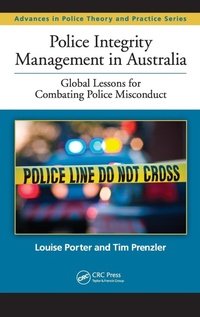
Police Integrity Management in Australia
Global Lessons for Combating Police Misconduct
1st Edition
Published on 6. April 2012
Book
Hardback
296 pages
978-1-4398-9598-6 (ISBN)
Description
In the past two decades, Australia has been the site of major police misconduct scandals and inquiries, leading to reform initiatives at the cutting edge of police integrity management practices. Presenting interviews with key informants and an analysis of key documents, Police Integrity Management in Australia: Global Lessons for Combating Police Misconduct offers a comprehensive study, conducted from 2008 to 2010, of strategies and systems in Australia.
Providing a rare overview and critique of a full suite of policies, institutions, and programs adopted to combat misconduct in policing, this volume:
Outlines the global problem of police misconduct and its effects
Summarizes current knowledge about best practices in the field, the reality of corruption in Australia, and the reform agenda that has driven major change and experimentation
Presents current integrity strategies in place in Australia, covering the rationales, evidence of effectiveness, and difficulties
Explores undercover stings, drug and alcohol testing, mediation of complaints, ethics training, and regulating the police use of force
Organized logically for ease of navigation, each chapter contains an "Emerging Issues" section, highlighting some of the more promising and/or innovative integrity strategies as well as looming concerns and ethical issues.
The book concludes with an overall evaluation of the data presented in the body of the book, assessing the strengths and weaknesses of the Australian system and the implications for adoption of these strategies in other police departments around the world.
Providing a rare overview and critique of a full suite of policies, institutions, and programs adopted to combat misconduct in policing, this volume:
Outlines the global problem of police misconduct and its effects
Summarizes current knowledge about best practices in the field, the reality of corruption in Australia, and the reform agenda that has driven major change and experimentation
Presents current integrity strategies in place in Australia, covering the rationales, evidence of effectiveness, and difficulties
Explores undercover stings, drug and alcohol testing, mediation of complaints, ethics training, and regulating the police use of force
Organized logically for ease of navigation, each chapter contains an "Emerging Issues" section, highlighting some of the more promising and/or innovative integrity strategies as well as looming concerns and ethical issues.
The book concludes with an overall evaluation of the data presented in the body of the book, assessing the strengths and weaknesses of the Australian system and the implications for adoption of these strategies in other police departments around the world.
More details
Series
Language
English
Place of publication
New York
United States
Publishing group
Taylor & Francis Inc
Target group
College/higher education
Policymakers, researchers, instructors, and police managers.
Illustrations
5 s/w Abbildungen, 7 s/w Tabellen
7 Tables, black and white; 5 Illustrations, black and white
Dimensions
Height: 240 mm
Width: 161 mm
Thickness: 21 mm
Weight
614 gr
ISBN-13
978-1-4398-9598-6 (9781439895986)
Copyright in bibliographic data and cover images is held by Nielsen Book Services Limited or by the publishers or by their respective licensors: all rights reserved.
Schweitzer Classification
Other editions
Additional editions
Louise Porter | Tim Prenzler
Police Integrity Management in Australia
Global Lessons for Combating Police Misconduct
Book
12/2019
1st Edition
Routledge
€74.20
Shipment within 15-20 days
Louise Porter | Tim Prenzler
Police Integrity Management in Australia
Global Lessons for Combating Police Misconduct
E-Book
04/2012
1st Edition
Routledge
€67.49
Available for download
Louise Porter | Tim Prenzler
Police Integrity Management in Australia
Global Lessons for Combating Police Misconduct
E-Book
04/2012
1st Edition
Routledge
€67.49
Available for download
Persons
Louise Porter is a Research Fellow in the Australian Research Council Centre of Excellence in Policing and Security (CEPS) based at Griffith University, Brisbane. She has a BSc (Hons) from the University of Leicester, UK, and an MSC and PhD in Psychology from the University of Liverpool, UK. She is a British Psychological Society Chartered Psychologist and formerly a Lecturer in forensic psychology in the United Kingdom. Her research interests center on interpersonal processes, specifically leadership and peer influence in forensic contexts. Dr. Porter has explored social and organizational features of group crime and, most recently, police corruption and misconduct. Her work on police misconduct has focused on types of misconduct behavior, its causes, and the systems in place to address such behavior. She is also interested in police-citizen interactions, police use of force, and police-related deaths.
Tim Prenzler is a Chief Investigator in the Australian Research Council Centre of Excellence in Policing and Security (CEPS) and a Professor in the School of Criminology and Criminal Justice, Griffith University, Brisbane. He holds a PhD, MA, and BA (Hons). In CEPS, he manages the Integrity Systems Project, which is focused on advancing knowledge about effective integrity management strategies in policing and security. In 1991, he was a foundation member of the School of Criminology and Criminal Justice, where he developed and taught courses in situational crime prevention, security management, criminal justice ethics, social justice, and police studies. In addition to integrity research, his current work includes studies on police and security officer safety, security industry regulation, reducing welfare fraud, and improving the integration of women police.
Tim Prenzler is a Chief Investigator in the Australian Research Council Centre of Excellence in Policing and Security (CEPS) and a Professor in the School of Criminology and Criminal Justice, Griffith University, Brisbane. He holds a PhD, MA, and BA (Hons). In CEPS, he manages the Integrity Systems Project, which is focused on advancing knowledge about effective integrity management strategies in policing and security. In 1991, he was a foundation member of the School of Criminology and Criminal Justice, where he developed and taught courses in situational crime prevention, security management, criminal justice ethics, social justice, and police studies. In addition to integrity research, his current work includes studies on police and security officer safety, security industry regulation, reducing welfare fraud, and improving the integration of women police.
Content
Introduction: Police Misconduct and Integrity, International and Australian Perspectives. Commonwealth. New South Wales. Northern Territory. Queensland. South Australia. Tasmania. Victoria. Western Australia. Critique and Recommendations. References. Legislation. Advances in Police Theory and Practice. Index.