

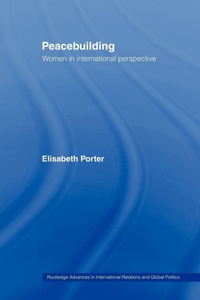
Peacebuilding
Women in International Perspective
1st Edition
Published on 24. July 2008
Book
Paperback/Softback
248 pages
978-0-415-47973-8 (ISBN)
Description
This book clarifies some key ideas and practices underlying peacebuilding; understood broadly as formal and informal peace processes that occur during pre-conflict, conflict and post-conflict transformation.
Applicable to all peacebuilders, Elisabeth Porter highlights positive examples of women's peacebuilding in comparative international contexts. She critically interrogates accepted and entrenched dualisms that prevent meaningful reconciliation, while also examining the harm of othering and the importance of recognition, inclusion and tolerance. Drawing on feminist ethics, the book develops a politics of compassion that defends justice, equality and rights and the need to restore victims' dignity. Complex issues of memory, truth, silence and redress are explored while new ideas on reconciliation and embracing difference emerge.
Many ideas challenge orthodox understandings of peace. The arguments developed here demonstrate how peacebuilding can be understood more broadly than current United Nations and orthodox usages so that women's activities in conflict and transitional societies can be valued as participating in building sustainable peace with justice. Theoretically integrating peace and conflict studies, international relations, political theory and feminist ethics, this book focuses on the lessons to be learned from best practices of peacebuilding situated around the UN Security Council Resolution 1325 on Women, Peace and Security.
Peacebuilding will be of particular interest to peace practitioners and to students and researchers of peace and conflict studies, international relations and gender politics.
Applicable to all peacebuilders, Elisabeth Porter highlights positive examples of women's peacebuilding in comparative international contexts. She critically interrogates accepted and entrenched dualisms that prevent meaningful reconciliation, while also examining the harm of othering and the importance of recognition, inclusion and tolerance. Drawing on feminist ethics, the book develops a politics of compassion that defends justice, equality and rights and the need to restore victims' dignity. Complex issues of memory, truth, silence and redress are explored while new ideas on reconciliation and embracing difference emerge.
Many ideas challenge orthodox understandings of peace. The arguments developed here demonstrate how peacebuilding can be understood more broadly than current United Nations and orthodox usages so that women's activities in conflict and transitional societies can be valued as participating in building sustainable peace with justice. Theoretically integrating peace and conflict studies, international relations, political theory and feminist ethics, this book focuses on the lessons to be learned from best practices of peacebuilding situated around the UN Security Council Resolution 1325 on Women, Peace and Security.
Peacebuilding will be of particular interest to peace practitioners and to students and researchers of peace and conflict studies, international relations and gender politics.
More details
Series
Language
English
Place of publication
London
United Kingdom
Publishing group
Taylor & Francis Ltd
Target group
College/higher education
Dimensions
Height: 234 mm
Width: 156 mm
Thickness: 14 mm
Weight
383 gr
ISBN-13
978-0-415-47973-8 (9780415479738)
Copyright in bibliographic data and cover images is held by Nielsen Book Services Limited or by the publishers or by their respective licensors: all rights reserved.
Schweitzer Classification
Other editions
Additional editions
Book
10/2007
1st Edition
Routledge
€231.80
Shipment within 15-20 days
E-Book
09/2007
Routledge
€77.99
Available for download
E-Book
09/2007
Routledge
€77.99
Available for download
Person
Elisabeth Porter is Head of School of International Studies at the University of South Australia.
Content
1. Peacebuilding as Process 2. Overcoming the Harm of Polarization 3. Recognition and Inclusion 4. Justice and Compassion 5. Memory and Truth 6. Reconciliation and Difference Conclusion: Peace with Justice and Security