

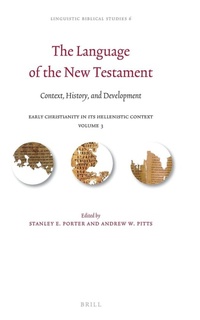
The Language of the New Testament
Context, History, and Development
Published on 21. February 2013
Book
Hardback
536 pages
978-90-04-23477-2 (ISBN)
Description
In The Language of the New Testament, Stanley E. Porter and Andrew W. Pitts assemble an international team of scholars whose work has focused on the Greek language of the earliest Christians. Each essay moves forward the current understanding of the context, history or development of the language of the New Testament. The first section of the volume focuses on the social contexts and registers that provide the environment for language use and selection. The second section deals with issues surrounding the history of the Greek language and how its development has impacted the Greek found within the New Testament.
More details
Series
Language
English
Place of publication
Leiden
Netherlands
Target group
Professional and scholarly
All interested in Hellenistic, Classical, and Koine Greek, New Testament, Linguistics, Atticism, Papyri.
Product notice
Laminated cover
Dimensions
Height: 235 mm
Width: 155 mm
Thickness: 30 mm
Weight
922 gr
ISBN-13
978-90-04-23477-2 (9789004234772)
Copyright in bibliographic data and cover images is held by Nielsen Book Services Limited or by the publishers or by their respective licensors: all rights reserved.
Schweitzer Classification
Persons
Stanley E. Porter, Ph.D. (1988), University of Sheffield, is President and Dean, and Professor of New Testament, at McMaster Divinity College in Hamilton, Ontario, Canada. He has published numerous monographs, edited volumes, and articles in the field of New Testament studies and related disciplines, including Hermeneutics: An Introduction to Interpretive Theory (2011).
Andrew W. Pitts<.b> is a Ph.D. candidate in Christian Theology (New Testament) at McMaster Divinity College in Hamilton, Ontario, Canada, and has published articles in journals such as JBL, JGRChJ and CBR, as well as a number of chapters in edited volumes.
Andrew W. Pitts<.b> is a Ph.D. candidate in Christian Theology (New Testament) at McMaster Divinity College in Hamilton, Ontario, Canada, and has published articles in journals such as JBL, JGRChJ and CBR, as well as a number of chapters in edited volumes.
Content
1. Stanley E. Porter and Andrew W. Pitts, The Language of the New Testament: An Introductory Essay Context 2. Jonathan M. Watt, Some Implications of Bilingualism for New Testament Exegesis 3. Stanley E. Porter. What Can We Learn about Greek Grammar from a Mosaic? 4. Rodney J. Decker, Markan Idiolect in the Study of the Greek of the New Testament 5. Frederick William Danker, A Linguistic-Cultural Approach to Alleged Pauline and Lukan Christological Disparity 6. Sean A. Adams, Atticism, Classicism, and Luke-Acts: Discussions with Albert Wifstrand and Loveday Alexander 7. Fredrick J. Long, Roman Imperial Rule under the Authority of Jupiter-Zeus: Political-Religious Contexts and the Interpretation of 'the Ruler of the Authority of the Air' in Ephesians 2:2 8. Jan Henrik Nylund, The Prague School of Linguistics and Its Influence on New Testament Language Studies History 9. Jonathan M. Watt, A Brief History of Ancient Greek with a View to the New Testament 10. Christopher Land, Varieties of Greek Language 11. Andrew W. Pitts, Greek Case in the Hellenistic and Byzantine Grammarians 12. John A.L. Lee, The Atticist Grammarians Development 13. Andrew W. Pitts, Greek Word Order and Clause Structure: A Comparative Study of Some New Testament Corpora 14. Rodney J. Decker, The Function of the Imperfect Tense in Mark's Gospel 15. Paul Danove, A Comparison of the Usages of deltaiotadeltaomegamuiota and deltaiotadeltaomegamuiota Compounds in the Septuagint and New Testament 17. Francis Gignac, Grammatical Developments of Greek in Roman Egypt Significant for the New Testament 18. Stanley E. Porter and Andrew W. Pitts. The Disclosure Formula in the Epistolary Papyri: Development, Form, Function, and Syntax Index of Modern Authors Index of Ancient Sources