

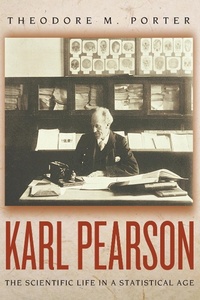
Karl Pearson
The Scientific Life in a Statistical Age
Published on 8. January 2006
Book
Paperback/Softback
352 pages
978-0-691-12635-7 (ISBN)
Description
Karl Pearson, founder of modern statistics, came to this field by way of passionate early studies of philosophy and cultural history as well as ether physics and graphical geometry. His faith in science grew out of a deeply moral quest, reflected also in his socialism and his efforts to find a new basis for relations between men and women. This biography recounts Pearson's extraordinary intellectual adventure and sheds new light on the inner life of science. Theodore Porter's intensely personal portrait of Pearson extends from religious crisis and sexual tensions to metaphysical and even mathematical anxieties. Pearson sought to reconcile reason with enthusiasm and to achieve the impersonal perspective of science without sacrificing complex individuality. Even as he longed to experience nature directly and intimately, he identified science with renunciation and positivistic detachment. Porter finds a turning point in Pearson's career, where his humanistic interests gave way to statistical ones, in his Grammar of Science (1892), in which he attempted to establish scientific method as the moral educational basis for a refashioned culture.
In this original and engaging book, a leading historian of modern science investigates the interior experience of one man's scientific life while placing it in a rich tapestry of social, political, and intellectual movements.
In this original and engaging book, a leading historian of modern science investigates the interior experience of one man's scientific life while placing it in a rich tapestry of social, political, and intellectual movements.
Reviews / Votes
"Theodore Porter's book on Pearson is not a biography in the conventional sense. It focuses on the early part of his career in an effort to show how he was drawn to the study of statistics and eventually conceived it as the key to a new philosophy of nature, which was to become his life's work... The great value of Porter's book is that this focus on the early phase of Pearson's career highlights the complex route by which his quest for emotional and intellectual satisfaction led him towards the project that would, in effect, create modern statistics."--Peter J. Bowler, Nature "[A] brilliant biography, one can hardly imagine a better summary of Karl Pearson's fascinating life and complicated persona... [Porter] reveals more about the origins, aspirations, and consequences of modern statistics than any technical treatise of the same length could possibly accomplish. As Porter emphasizes, Pearson's life was a tour de force [and] extremely fascinating to the reader."--Manfred D. Laubichler, Science "Porter's biography of the young Pearson, the statistician in embryo, exceeds all expectations in recreating the intellectual worlds in which Pearson tried to find a home. The breadth of the reading and the depth of interpretation are impressive... Porter shows us a young Pearson, clever and brave, who has a burning passion to understand things."--John Aldrich, American Scientist "This book is a remarkable achievement."--Jenny Marie, Journal of the History of Biology "Pearson's story can ... be read as a triumph of statistics in which a powerful intellect comes to see our field as a great source of enlightenment. As [Theodore M.] Porter writes in a wonderful first sentence, 'Beginning in 1892, when he took up statistics as his scientific vocation, Karl Pearson devoted himself relentlessly to a project of almost universal quantification.' That sentence very effectively conveys what I try to tell my students in a first statistics course, that this is a way of thinking which will allow them to see the world in a new and beautiful way, though I do hope that they avoid adopting Pearson's unwavering commitment that statistics is the only way to view the world."--Richard J. Cleary, The American Statistician "Theodore Porter's Karl Pearson explores the fullness and richness of Pearson's intellectual and emotional life, shows us how 'the toil of the years' led to the revolution he wrought in statistics... The book would ... be a source of both pleasure and profit to any serious reader."--Ramachandran Bharath, MAA ReviewsMore details
Language
English
Place of publication
New Jersey
United States
Target group
Professional and scholarly
College/higher education
Product notice
Paperback (trade)
Illustrations
18 halftones.
Dimensions
Height: 234 mm
Width: 156 mm
Thickness: 21 mm
Weight
603 gr
ISBN-13
978-0-691-12635-7 (9780691126357)
Copyright in bibliographic data and cover images is held by Nielsen Book Services Limited or by the publishers or by their respective licensors: all rights reserved.
Schweitzer Classification
Other editions
Additional editions
E-Book
01/2010
1st Edition
Princeton University Press
€171.95
Available for download
Book
02/2004
Princeton University Press
€71.80
Article exhausted; check different version
Person
Theodore Porter is Professor of History at UCLA and author of "The Rise of Statistical Thinking" and "Trust in Numbers" (both Princeton)
Content
Preface and Acknowledgments vii CHAPTER ONE Introduction: An Improbable Personage 1 CHAPTER TWO Lehrjahre of a Poetic Wrangler 13 CHAPTER THREE Apostle of Renunciation: A New Werther 43 CHAPTER FOUR Pearson's Progress: A Nineteenth-Century Passion Play 69 CHAPTER FIVE Cultural Historian in a Political Age 91 CHAPTER SIX Intellectual Love and the Woman Question 125 CHAPTER SEVEN Ether Squirts and the Inaccessibility of Nature 178 CHAPTER EIGHT Scientific Education and Graphical Statistics 215 CHAPTER NINE The Statistical Reformation 249 CHAPTER TEN Epilogue: Composing a Life 297 Bibliography 315 Index 329