

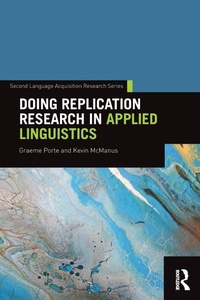
Doing Replication Research in Applied Linguistics
1st Edition
Published on 9. January 2019
Book
Paperback/Softback
182 pages
978-1-138-65735-9 (ISBN)
Description
Doing Replication Research in Applied Linguistics is the only book available to specifically discuss the applied aspects of how to carry out replication studies in Applied Linguistics. This text takes the reader from seeking out a suitable study for replication, through deciding on the most valuable form of replication approach, to its execution, discussion, and writing up for publication. A step-by-step decision-making approach to the activities guides the reader through the replication research process from the initial search for a target study to replicate, through the setting up, execution, analysis, and dissemination of the finished work.
More details
Series
Language
English
Place of publication
London
United Kingdom
Publishing group
Taylor & Francis Ltd
Target group
College/higher education
Illustrations
1 s/w Photographie bzw. Rasterbild, 1 s/w Zeichnung, 4 s/w Tabellen
4 Tables, black and white; 1 Line drawings, black and white; 1 Halftones, black and white
Dimensions
Height: 229 mm
Width: 152 mm
Thickness: 11 mm
Weight
287 gr
ISBN-13
978-1-138-65735-9 (9781138657359)
Copyright in bibliographic data and cover images is held by Nielsen Book Services Limited or by the publishers or by their respective licensors: all rights reserved.
Schweitzer Classification
Other editions
Additional editions
Graeme Porte | Kevin McManus
Doing Replication Research in Applied Linguistics
Book
01/2019
1st Edition
Routledge
€206.00
Shipment within 10-20 days
Graeme Porte | Kevin McManus
Doing Replication Research in Applied Linguistics
E-Book
12/2018
Routledge
€65.99
Available for download
Graeme Porte | Kevin McManus
Doing Replication Research in Applied Linguistics
E-Book
12/2018
1st Edition
Routledge
€65.99
Available for download
Persons
Graeme Porte is Senior Lecturer in English Language and Applied Linguistics at the University of Granada, Spain. He has been Editor of the Cambridge University Press journal Language Teaching for 15 years and lectures and writes on quantitative research methods with a particular emphasis on research critique and replication research.
Kevin McManus is Watz Early Career Professor in Language and Linguistics, Associate Director of the Center for Language Acquisition, and Assistant Professor of Applied Linguistics at the Pennsylvania State University, USA. His research specializations include second language learning and teaching, psycholinguistics, research methodology, and replication research.
Kevin McManus is Watz Early Career Professor in Language and Linguistics, Associate Director of the Center for Language Acquisition, and Assistant Professor of Applied Linguistics at the Pennsylvania State University, USA. His research specializations include second language learning and teaching, psycholinguistics, research methodology, and replication research.
Content
Contents
1
Introduction: Why replication research matters
2
Finding a study to replicate: Background research
3
Planning your replication research project
4
What kind of replication should you do? From the inside, looking out: initial critique and internal replication
5
What kind of replication should you do? From the outside, looking in
6
Executing and writing up your replication study: Research questions and methodology
7
Executing and writing up your replication study: Analysis, Results, Discussion and Conclusion
8
Disseminating your research
9
Epilogue
1
Introduction: Why replication research matters
2
Finding a study to replicate: Background research
3
Planning your replication research project
4
What kind of replication should you do? From the inside, looking out: initial critique and internal replication
5
What kind of replication should you do? From the outside, looking in
6
Executing and writing up your replication study: Research questions and methodology
7
Executing and writing up your replication study: Analysis, Results, Discussion and Conclusion
8
Disseminating your research
9
Epilogue