

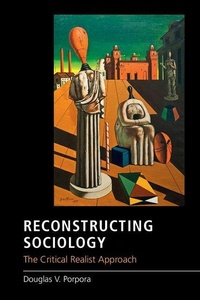
Reconstructing Sociology
The Critical Realist Approach
Published on 31. August 2015
Book
Paperback/Softback
249 pages
978-1-107-51471-3 (ISBN)
Description
Critical realism is a philosophy of science that positions itself against the major alternative philosophies underlying contemporary sociology. This book offers a general critique of sociology, particularly sociology in the United States, from a critical realist perspective. It also acts as an introduction to critical realism for students and scholars of sociology. Written in a lively, accessible style, Douglas V. Porpora argues that sociology currently operates with deficient accounts of truth, culture, structure, agency, and causality that are all better served by a critical realist perspective. This approach argues against the alternative sociological perspectives, in particular the dominant positivism which privileges statistical techniques and experimental design over ethnographic and historical approaches. However, the book also compares critical realism favourably with a range of other approaches, including poststructuralism, pragmatism, interpretivism, practice theory, and relational sociology. Numerous sociological examples are included, and each chapter addresses well-known and current work in sociology.
Reviews / Votes
'American sociology badly needs to learn critical realism and to rethink its assumptions, practices, and standards in realist terms. Doug Porpora here provides an easy but smart on-ramp into critical realism for sociology that I hope serves as an introduction to realism that many students and scholars use to gain a new perspective on our discipline.' Christian Smith, Wm. R. Kenan, Jr Professor of Sociology, University of Notre Dame, and author of To Flourish or Destruct: A Personalist Theory of Human Goods, Motivations, Failure, and Evil 'Doug Porpora has written a wonderful new book - clear, sensible, engaging, comprehensive and very, very smart - designed to demystify critical realism for sociologists, social theorists, social ontologists or anyone else interested in the nature of social reality or in the methods and philosophy of realist social science. It is bound to become a classic point of entry for readers new to the topic.' Ruth Groff, Saint Louis University 'For years we lacked Porpora's book to situate critical realism in the sociological landscape. His bold engagement with current theorizing is consistently sure-footed; an exceptionally intelligent and unusually readable feat.' Margaret S. Archer, University of Warwick 'Critical realism is hard to categorize. It appears to be a philosophy of science, which Porpora thinks sociology should adopt ... Sociologists should abandon the vision of 'value neutrality' and instead proudly proclaim themselves as engaged and trying to transform the world. Summing up: recommended. Upper-division undergraduates and above.' Y. R. Magrass, Choice 'This is a book that is needed, especially by doctoral students and early career researchers.' Margaret S. Archer, Journal of Critical RealismMore details
Language
English
Place of publication
Cambridge
United Kingdom
Target group
Professional and scholarly
Product notice
Paperback (trade)
Illustrations
1 Tables, black and white; 1 Line drawings, unspecified
Dimensions
Height: 229 mm
Width: 152 mm
Thickness: 14 mm
Weight
374 gr
ISBN-13
978-1-107-51471-3 (9781107514713)
Copyright in bibliographic data and cover images is held by Nielsen Book Services Limited or by the publishers or by their respective licensors: all rights reserved.
Schweitzer Classification
Other editions
Additional editions
Book
09/2015
Cambridge University Press
€97.50
Shipment within 15-20 days
Person
Douglas V. Porpora is a Professor of Sociology at Drexel University, Philadelphia. His previous publications include Post-Ethical Society: The Iraq War, Abu Ghraib, and the Moral Failure of the Secular (2013).
Content
1. Seven myths of American sociology; 2. Do realists run regressions?; 3. What is truth?; 4. Whatever happened to social structure?; 5. Are we not men - or, rather, persons?; 6. What and where is culture?; 7. Do we need critical realism?; 8. So what do we do with it?