

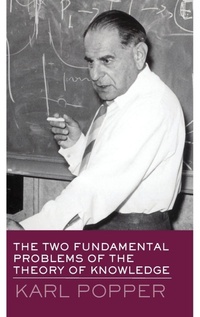
The Two Fundamental Problems of the Theory of Knowledge
Translation by Andreas Pickel
Published on 2. October 2008
Book
Hardback
512 pages
978-0-415-39431-4 (ISBN)
Description
In a letter of 1932, Karl Popper described Die beiden Grundprobleme der Erkenntnistheorie - The Two Fundamental Problems of the Theory of Knowledge - as '...a child of crises, above all of ...the crisis of physics.'
Finally available in English, it is a major contribution to the philosophy of science, epistemology and twentieth century philosophy generally.
The two fundamental problems of knowledge that lie at the centre of the book are the problem of induction, that although we are able to observe only a limited number of particular events, science nevertheless advances unrestricted universal statements; and the problem of demarcation, which asks for a separating line between empirical science and non-science.
Popper seeks to solve these two basic problems with his celebrated theory of falsifiability, arguing that the inferences made in science are not inductive but deductive; science does not start with observations and proceed to generalise them but with problems, which it attacks with bold conjectures.
The Two Fundamental Problems of the Theory of Knowledge is essential reading for anyone interested in Karl Popper, in the history and philosophy of science, and in the methods and theories of science itself.
Finally available in English, it is a major contribution to the philosophy of science, epistemology and twentieth century philosophy generally.
The two fundamental problems of knowledge that lie at the centre of the book are the problem of induction, that although we are able to observe only a limited number of particular events, science nevertheless advances unrestricted universal statements; and the problem of demarcation, which asks for a separating line between empirical science and non-science.
Popper seeks to solve these two basic problems with his celebrated theory of falsifiability, arguing that the inferences made in science are not inductive but deductive; science does not start with observations and proceed to generalise them but with problems, which it attacks with bold conjectures.
The Two Fundamental Problems of the Theory of Knowledge is essential reading for anyone interested in Karl Popper, in the history and philosophy of science, and in the methods and theories of science itself.
More details
Series
Language
English
Place of publication
London
United Kingdom
Publishing group
Taylor & Francis Ltd
Target group
College/higher education
Professional and scholarly
Postgraduate and Undergraduate
Illustrations
5 s/w Tabellen
5 Tables, black and white
Dimensions
Height: 240 mm
Width: 161 mm
Thickness: 34 mm
Weight
986 gr
ISBN-13
978-0-415-39431-4 (9780415394314)
Copyright in bibliographic data and cover images is held by Nielsen Book Services Limited or by the publishers or by their respective licensors: all rights reserved.
Schweitzer Classification
Other editions
Additional editions

Karl Popper | Troels Eggers Hansen
The Two Fundamental Problems of the Theory of Knowledge
E-Book
05/2014
1st Edition
Routledge
€31.49
Available for download

Karl Popper | Troels Eggers Hansen
The Two Fundamental Problems of the Theory of Knowledge
E-Book
05/2014
1st Edition
Routledge
€31.49
Available for download

Karl Popper | Troels Eggers Hansen
The Two Fundamental Problems of the Theory of Knowledge
Book
08/2011
Routledge
€47.20
Shipment within 15-20 days
Persons
Karl Popper (1902-94). Philosopher, born in Vienna. One of the most influential and controversial thinkers of the twentieth century.
Content
Preface Introduction Book 1: The Problem of Induction (Experience and Hypothesis) The Two Fundamental Problems of the Theory of Knowledge Volume One Book 2: The Problem of Demarcation (Experience and Metaphysics) The Two Fundamental Problems of the Theory of Knowledge Volume Two (Fragments) Editor's Postscript