

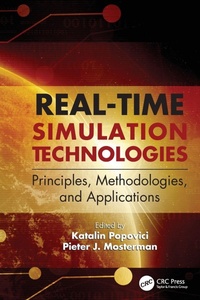
Real-Time Simulation Technologies: Principles, Methodologies, and Applications
Principles, Methodologies, and Applications
1st Edition
Published on 29. March 2017
Book
Paperback/Softback
660 pages
978-1-138-07755-3 (ISBN)
Description
Real-Time Simulation Technologies: Principles, Methodologies, and Applications is an edited compilation of work that explores fundamental concepts and basic techniques of real-time simulation for complex and diverse systems across a broad spectrum. Useful for both new entrants and experienced experts in the field, this book integrates coverage of detailed theory, acclaimed methodological approaches, entrenched technologies, and high-value applications of real-time simulation-all from the unique perspectives of renowned international contributors.
Because it offers an accurate and otherwise unattainable assessment of how a system will behave over a particular time frame, real-time simulation is increasingly critical to the optimization of dynamic processes and adaptive systems in a variety of enterprises. These range in scope from the maintenance of the national power grid, to space exploration, to the development of virtual reality programs and cyber-physical systems. This book outlines how, for these and other undertakings, engineers must assimilate real-time data with computational tools for rapid decision making under uncertainty.
Clarifying the central concepts behind real-time simulation tools and techniques, this one-of-a-kind resource:
Discusses the state of the art, important challenges, and high-impact developments in simulation technologies
Provides a basis for the study of real-time simulation as a fundamental and foundational technology
Helps readers develop and refine principles that are applicable across a wide variety of application domains
As science moves toward more advanced technologies, unconventional design approaches, and unproven regions of the design space, simulation tools are increasingly critical to successful design and operation of technical systems in a growing number of application domains. This must-have resource presents detailed coverage of real-time simulation for system design, parallel and distributed simulations, industry tools, and a large set of applications.
Because it offers an accurate and otherwise unattainable assessment of how a system will behave over a particular time frame, real-time simulation is increasingly critical to the optimization of dynamic processes and adaptive systems in a variety of enterprises. These range in scope from the maintenance of the national power grid, to space exploration, to the development of virtual reality programs and cyber-physical systems. This book outlines how, for these and other undertakings, engineers must assimilate real-time data with computational tools for rapid decision making under uncertainty.
Clarifying the central concepts behind real-time simulation tools and techniques, this one-of-a-kind resource:
Discusses the state of the art, important challenges, and high-impact developments in simulation technologies
Provides a basis for the study of real-time simulation as a fundamental and foundational technology
Helps readers develop and refine principles that are applicable across a wide variety of application domains
As science moves toward more advanced technologies, unconventional design approaches, and unproven regions of the design space, simulation tools are increasingly critical to successful design and operation of technical systems in a growing number of application domains. This must-have resource presents detailed coverage of real-time simulation for system design, parallel and distributed simulations, industry tools, and a large set of applications.
More details
Series
Language
English
Place of publication
London
United Kingdom
Publishing group
Taylor & Francis Ltd
Target group
College/higher education
Engineers, researchers and developers in the field of simulation domains, undergraduate students, professors, manufacturers, and defense training and simulation based acquisition companies.
Illustrations
28 s/w Tabellen, 295 s/w Abbildungen
28 Tables, black and white; 295 Illustrations, black and white
Dimensions
Height: 234 mm
Width: 156 mm
Thickness: 35 mm
Weight
989 gr
ISBN-13
978-1-138-07755-3 (9781138077553)
Copyright in bibliographic data and cover images is held by Nielsen Book Services Limited or by the publishers or by their respective licensors: all rights reserved.
Schweitzer Classification
Other editions
Additional editions
Katalin Popovici | Pieter Mosterman
Real-Time Simulation Technologies: Principles, Methodologies, and Applications
E-Book
12/2017
1st Edition
CRC Press
€114.99
Available for download
Katalin Popovici | Pieter Mosterman
Real-Time Simulation Technologies: Principles, Methodologies, and Applications
E-Book
12/2017
CRC Press
€114.99
Available for download
Katalin Popovici | Pieter Mosterman
Real-Time Simulation Technologies: Principles, Methodologies, and Applications
Principles, Methodologies, and Applications
Book
08/2012
1st Edition
CRC Press
€300.40
Shipment within 15-20 days
Persons
Katalin Popovici received her engineer degree in computer science from the University of Oradea, Romania, in 2004 and her Ph.D in micro- and nanoelectronics from Grenoble Institute of Technology, France, in 2008. Between 2005 and 2008, she was a member of the SHAPES (Scalable Software Hardware Computing Architecture Platform for Embedded Systems) European research project, where she worked on hardware-software co-design. Currently, she is a senior software engineer at MathWorks in Natick, Massachusetts, where she works on partitioning and mapping capabilities from Simulink (R) models to embedded and real-time systems, with focus on code generation for multicore and heterogeneous architectures.
Pieter J. Mosterman is a senior research scientist at MathWorks in Natick, Massachusetts, where he works on design automation technologies. He also holds an adjunct professor position in the School of Computer Science at McGill University. Prior to this, he was a research associate at the German Aerospace Center (DLR) in Oberpfaffenhofen. He received his Ph.D in electrical and computer engineering from Vanderbilt University in Nashville, Tennessee, and his MSc in electrical engineering from the University of Twente, The Netherlands. His primary research interests include computer automated multiparadigm modeling with principal applications in design automation, training systems, and fault detection, isolation, and reconfiguration.
Pieter J. Mosterman is a senior research scientist at MathWorks in Natick, Massachusetts, where he works on design automation technologies. He also holds an adjunct professor position in the School of Computer Science at McGill University. Prior to this, he was a research associate at the German Aerospace Center (DLR) in Oberpfaffenhofen. He received his Ph.D in electrical and computer engineering from Vanderbilt University in Nashville, Tennessee, and his MSc in electrical engineering from the University of Twente, The Netherlands. His primary research interests include computer automated multiparadigm modeling with principal applications in design automation, training systems, and fault detection, isolation, and reconfiguration.
Content
Section I: Basic Simulation Technologies and Fundamentals
Real-Time Simulation Using Hybrid Models. Formalized Approach for the Design of Real-Time Distributed Computer Systems. Principles of DEVS Model Verification for Real-Time Embedded Applications. Optimizing Discrete Modeling and Simulation for Real-Time Constraints with Metaprogramming. Modeling with UML and Its Real-Time Profiles. Modeling and Simulation of Timing Behavior with the Timing Definition Language.
Section II: Real-Time Simulation for System Design
Progressive Simulation-Based Design for Networked Real-Time Embedded Systems. Validator Tool Suite: Filling the Gap between Conventional Software-in-the-Loop and Hardware-in-the-Loop Simulation Environments. Modern Methodology of Electric System Design Using Rapid-Control Prototyping and Hardware-in-the-Loop. Modeling Multiprocessor Real-Time Systems at Transaction Level. Service-Based Simulation Framework for Performance Estimation of Embedded Systems. Consistency Management of UML Models.
Section III: Parallel and Distributed Real-Time Simulation
Interactive Flight Control System Development and Validation with Real-Time Simulation. Test Bed for Evaluation of Power Grid Cyber-Infrastructure. System Approach to Simulations for Training: Instruction, Technology, and Process Engineering. Concurrent Simulation for Online Optimization of Discrete Event Systems.
Section IV: Tools and Applications
Toward Accurate Simulation of Large-Scale Systems via Time Dilation. Simulation for Operator Training in Production Machinery. Real-Time Simulation Platform for Controller Design, Test, and Redesign. Automotive Real-Time Simulation: Modeling and Applications. Specification and Simulation of Automotive Functionality Using AUTOSAR. Modelica as a Platform for Real-Time Simulation. Real-Time Simulation of Physical Systems Using Simscape (TM). Systematic Derivation of Hybrid System Models for Hydraulic Systems.
Real-Time Simulation Using Hybrid Models. Formalized Approach for the Design of Real-Time Distributed Computer Systems. Principles of DEVS Model Verification for Real-Time Embedded Applications. Optimizing Discrete Modeling and Simulation for Real-Time Constraints with Metaprogramming. Modeling with UML and Its Real-Time Profiles. Modeling and Simulation of Timing Behavior with the Timing Definition Language.
Section II: Real-Time Simulation for System Design
Progressive Simulation-Based Design for Networked Real-Time Embedded Systems. Validator Tool Suite: Filling the Gap between Conventional Software-in-the-Loop and Hardware-in-the-Loop Simulation Environments. Modern Methodology of Electric System Design Using Rapid-Control Prototyping and Hardware-in-the-Loop. Modeling Multiprocessor Real-Time Systems at Transaction Level. Service-Based Simulation Framework for Performance Estimation of Embedded Systems. Consistency Management of UML Models.
Section III: Parallel and Distributed Real-Time Simulation
Interactive Flight Control System Development and Validation with Real-Time Simulation. Test Bed for Evaluation of Power Grid Cyber-Infrastructure. System Approach to Simulations for Training: Instruction, Technology, and Process Engineering. Concurrent Simulation for Online Optimization of Discrete Event Systems.
Section IV: Tools and Applications
Toward Accurate Simulation of Large-Scale Systems via Time Dilation. Simulation for Operator Training in Production Machinery. Real-Time Simulation Platform for Controller Design, Test, and Redesign. Automotive Real-Time Simulation: Modeling and Applications. Specification and Simulation of Automotive Functionality Using AUTOSAR. Modelica as a Platform for Real-Time Simulation. Real-Time Simulation of Physical Systems Using Simscape (TM). Systematic Derivation of Hybrid System Models for Hydraulic Systems.