

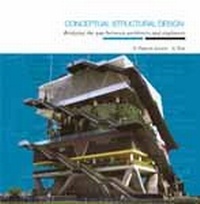
Conceptual Structural Design: Bridging the Gap between Architects and Engineers
1st Edition
Published on 1. December 2003
Book
Paperback/Softback
232 pages
978-0-7277-3235-4 (ISBN)
Description
This book aims to bridge the gap between engineers and architects understanding of structural form. It aims to inspire designers to develop innovative and viable structural forms.This book is presented in two parts. The first part is theoretical and investigates source of inspiration for developing structural form; learning from natural forms; applying our own intuition; seeking inspiration from precedents; applying understanding of structural principles; and developing design through physical models.The second part is presented through four case studies.
More details
Language
English
Place of publication
United Kingdom
Publishing group
Emerald Publishing Limited
Target group
Professional and scholarly
Dimensions
Height: 210 mm
Width: 210 mm
Weight
400 gr
ISBN-13
978-0-7277-3235-4 (9780727732354)
DOI
10.1680/csdbtgbaae.32354
Copyright in bibliographic data and cover images is held by Nielsen Book Services Limited or by the publishers or by their respective licensors: all rights reserved.
Schweitzer Classification
Content
Introduction
Lessons from Nature - design through evolution
Primitive Structures - design through intuition
Master builders and beyond - design from precedent
Scientific principles and new materials - design through new possibilities
Learning from physical models - design through experimentation
Case study 1: Clearwater garden pavilion by Sarah Wigglesworth Architects and Jane Wernick Associates
Case study 2: Building with nothing at all: Glass Structures by Dirk Jan Postel and Robert Nijsse
Case study 3: Stacked landscape: Dutch Expo Pavilion 2000 by MVRDV and ABT Consulting Engineer
Case study 4: Capsules of plant life from Plant Earth: The Eden Project by Nicholas Grimshaw Architects and Anthony Hunt Associates
Postscript
Bibliography
Index
Lessons from Nature - design through evolution
Primitive Structures - design through intuition
Master builders and beyond - design from precedent
Scientific principles and new materials - design through new possibilities
Learning from physical models - design through experimentation
Case study 1: Clearwater garden pavilion by Sarah Wigglesworth Architects and Jane Wernick Associates
Case study 2: Building with nothing at all: Glass Structures by Dirk Jan Postel and Robert Nijsse
Case study 3: Stacked landscape: Dutch Expo Pavilion 2000 by MVRDV and ABT Consulting Engineer
Case study 4: Capsules of plant life from Plant Earth: The Eden Project by Nicholas Grimshaw Architects and Anthony Hunt Associates
Postscript
Bibliography
Index