

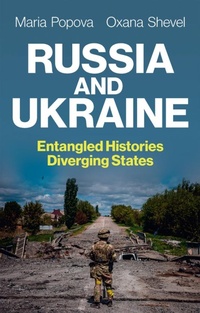
Russia and Ukraine
Entangled Histories, Diverging States
Published on 24. November 2023
Book
Paperback/Softback
288 pages
978-1-5095-5737-0 (ISBN)
Description
In February 2022, Russian missiles rained on Ukrainian cities and tanks rolled towards Kyiv to end Ukrainian independent statehood. President Zelensky declined a western evacuation offer and rallied the army and citizens to defend Ukraine. What are the roots of this war which has devastated Ukraine, upended the international legal order, and brought back the spectre of nuclear escalation? How is it that these supposedly "brotherly peoples" became each other's worst nightmare?
In Russia and Ukraine: Entangled Histories, Divergent States, Maria Popova and Oxana Shevel explain how over the last thirty years Russia and Ukraine diverged politically ending up on a catastrophic collision course. Russia slid back into authoritarianism and imperialism, while Ukraine consolidated a competitive political system and pro-European identity. As Ukraine built a democratic nation-state, Russia refused to accept it and came to see it as an "anti-Russia" project. After political pressure and economic levers proved ineffective and even counterproductive, Putin went to war to force Ukraine back into the fold of the "Russian world." Ukraine resisted, determined to pursue European integration as a sovereign state. These irreconcilable goals, rather than geopolitical wrangling between Russia and the West over NATO expansion, are - the authors argue - essential to understanding Russia's war on Ukraine.
In February 2022, Russian missiles rained on Ukrainian cities and tanks rolled towards Kyiv to end Ukrainian independent statehood. President Zelensky declined a western evacuation offer and rallied the army and citizens to defend Ukraine. What are the roots of this war which has devastated Ukraine, upended the international legal order, and brought back the spectre of nuclear escalation? How is it that these supposedly "brotherly peoples" became each other's worst nightmare?
In <i>Russia and Ukraine: Entangled Histories, Divergent States</i>, Maria Popova and Oxana Shevel explain how over the last thirty years Russia and Ukraine diverged politically ending up on a catastrophic collision course. Russia slid back into authoritarianism and imperialism, while Ukraine consolidated a competitive political system and pro-European identity. As Ukraine built a democratic nation-state, Russia refused to accept it and came to see it as an "anti-Russia" project. After political pressure and economic levers proved ineffective and even counterproductive, Putin went to war to force Ukraine back into the fold of the "Russian world." Ukraine resisted, determined to pursue European integration as a sovereign state. These irreconcilable goals, rather than geopolitical wrangling between Russia and the West over NATO expansion, are - the authors argue - essential to understanding Russia's war on Ukraine.
In Russia and Ukraine: Entangled Histories, Divergent States, Maria Popova and Oxana Shevel explain how over the last thirty years Russia and Ukraine diverged politically ending up on a catastrophic collision course. Russia slid back into authoritarianism and imperialism, while Ukraine consolidated a competitive political system and pro-European identity. As Ukraine built a democratic nation-state, Russia refused to accept it and came to see it as an "anti-Russia" project. After political pressure and economic levers proved ineffective and even counterproductive, Putin went to war to force Ukraine back into the fold of the "Russian world." Ukraine resisted, determined to pursue European integration as a sovereign state. These irreconcilable goals, rather than geopolitical wrangling between Russia and the West over NATO expansion, are - the authors argue - essential to understanding Russia's war on Ukraine.
In February 2022, Russian missiles rained on Ukrainian cities and tanks rolled towards Kyiv to end Ukrainian independent statehood. President Zelensky declined a western evacuation offer and rallied the army and citizens to defend Ukraine. What are the roots of this war which has devastated Ukraine, upended the international legal order, and brought back the spectre of nuclear escalation? How is it that these supposedly "brotherly peoples" became each other's worst nightmare?
In <i>Russia and Ukraine: Entangled Histories, Divergent States</i>, Maria Popova and Oxana Shevel explain how over the last thirty years Russia and Ukraine diverged politically ending up on a catastrophic collision course. Russia slid back into authoritarianism and imperialism, while Ukraine consolidated a competitive political system and pro-European identity. As Ukraine built a democratic nation-state, Russia refused to accept it and came to see it as an "anti-Russia" project. After political pressure and economic levers proved ineffective and even counterproductive, Putin went to war to force Ukraine back into the fold of the "Russian world." Ukraine resisted, determined to pursue European integration as a sovereign state. These irreconcilable goals, rather than geopolitical wrangling between Russia and the West over NATO expansion, are - the authors argue - essential to understanding Russia's war on Ukraine.
More details
Edition
1
Language
English
Place of publication
Oxford
United Kingdom
Publishing group
John Wiley and Sons Ltd
Target group
Professional and scholarly
Dimensions
Height: 227 mm
Width: 148 mm
Thickness: 21 mm
Weight
438 gr
ISBN-13
978-1-5095-5737-0 (9781509557370)
Copyright in bibliographic data and cover images is held by Nielsen Book Services Limited or by the publishers or by their respective licensors: all rights reserved.
Schweitzer Classification
Other editions
Additional editions
Book
11/2023
Polity Press
€65.00
Shipment within 15-20 days
E-Book
11/2023
1st Edition
Wiley
€18.99
Available for download
Persons
Maria Popova is Associate Professor of Political Science at McGill University.
Oxana Shevel is Associate Professor of Political Science at Tufts University.
<b>Maria Popova</b> is Associate Professor of Political Science at McGill University.
<b>Oxana Shevel</b> is Associate Professor of Political Science at Tufts University.
Oxana Shevel is Associate Professor of Political Science at Tufts University.
<b>Maria Popova</b> is Associate Professor of Political Science at McGill University.
<b>Oxana Shevel</b> is Associate Professor of Political Science at Tufts University.
Content
List of Abbreviations
List of Illustrations
Acknowledgements
Introduction: Russia's invasion and Ukraine's resistance
1. Entangled histories and identity debates
2. Regime divergence
3. Historical memory, language, and citizenship
4. Ukraine, Russia, and the West
5. Euromaidan, Crimea annexation, and the war in Donbas
6. The road to full-scale invasion
Conclusion
References
Notes
List of Illustrations
Acknowledgements
Introduction: Russia's invasion and Ukraine's resistance
1. Entangled histories and identity debates
2. Regime divergence
3. Historical memory, language, and citizenship
4. Ukraine, Russia, and the West
5. Euromaidan, Crimea annexation, and the war in Donbas
6. The road to full-scale invasion
Conclusion
References
Notes