

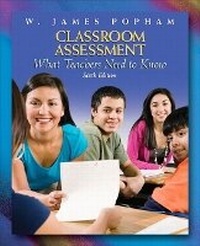
Classroom Assessment
What Teachers Need to Know
6th Edition
Published on 10. February 2010
Book
Paperback/Softback
528 pages
978-0-13-700233-7 (ISBN)
Description
Written with energy and wit, this reader-friendly text discusses practical ways in which teachers can use well-written tests to improve their effectiveness in the classroom.
Exploring a wide range of classroom assessments as well as how these assessments can benefit student learning, the thoroughly revised sixth edition of Classroom Assessment retains its humorous tone and unique practice exercises while adding new research, new material, and new features. This edition covers both contemporary classroom assessment issues, including No Child Left Behind, instructor accountability, and formative assessments, while also covering traditional assessment topics such as assessment validity and assessment reliability.
Three new chapters include fresh and expanded material on formative assessments, the evaluation of instruction, and properly grading assessments. In addition, a new section at the end of the book provides students with critical thinking exercises that involve real-world assessment issues and that cover central topics from each chapter. Another new feature teaches readers how to best communicate with parents about assessments and assessment results.
Exploring a wide range of classroom assessments as well as how these assessments can benefit student learning, the thoroughly revised sixth edition of Classroom Assessment retains its humorous tone and unique practice exercises while adding new research, new material, and new features. This edition covers both contemporary classroom assessment issues, including No Child Left Behind, instructor accountability, and formative assessments, while also covering traditional assessment topics such as assessment validity and assessment reliability.
Three new chapters include fresh and expanded material on formative assessments, the evaluation of instruction, and properly grading assessments. In addition, a new section at the end of the book provides students with critical thinking exercises that involve real-world assessment issues and that cover central topics from each chapter. Another new feature teaches readers how to best communicate with parents about assessments and assessment results.
More details
Edition
6th edition
Language
English
Place of publication
United States
Publishing group
Pearson Education (US)
Target group
Professional and scholarly
Dimensions
Height: 189 mm
Width: 234 mm
Thickness: 19 mm
Weight
782 gr
ISBN-13
978-0-13-700233-7 (9780137002337)
Copyright in bibliographic data is held by Nielsen Book Services Limited or its licensors: all rights reserved.
Schweitzer Classification
Other editions
New editions
Book
02/2013
7th Edition
Pearson
€123.16
Article exhausted; check for reprint
Book
02/2013
7th Edition
Pearson
€123.16
Article exhausted; check for reprint
Previous edition
Book
05/2007
5th Edition
Pearson
€78.17
Article exhausted; check for reprint
Person
W. James Popham began his career as a high school teacher in Oregon. He is professor emeritus at the UCLA Graduate School of Education and Information Studies. The author of 30 books, and a former president of the American Educational Research Association, he is the recipient of the National Council on Measurement in Education Award for Career Contributions to Educational Measurement.
Content
1 Why Do Teachers Need to Know about Assessment 2 Reliability of Assessment
3 Validity
4 Absence-of-Bias
5 Deciding What to Assess and How to Assess It
6 Selected-Response Tests
7 Constructed-Response Tests
8 Performance Assessment
9 Portfolio Assessment
10 Affective Assessment
11 Improving Teacher-Developed Assessments
12 Instructionally Oriented Assessment
13 Making Sense Out of Standardized Test Scores
14 Appropriate and Inappropriate Test-Preparation Practices
15 Evaluating Teaching and Grading Students
Glossary
Index
3 Validity
4 Absence-of-Bias
5 Deciding What to Assess and How to Assess It
6 Selected-Response Tests
7 Constructed-Response Tests
8 Performance Assessment
9 Portfolio Assessment
10 Affective Assessment
11 Improving Teacher-Developed Assessments
12 Instructionally Oriented Assessment
13 Making Sense Out of Standardized Test Scores
14 Appropriate and Inappropriate Test-Preparation Practices
15 Evaluating Teaching and Grading Students
Glossary
Index